
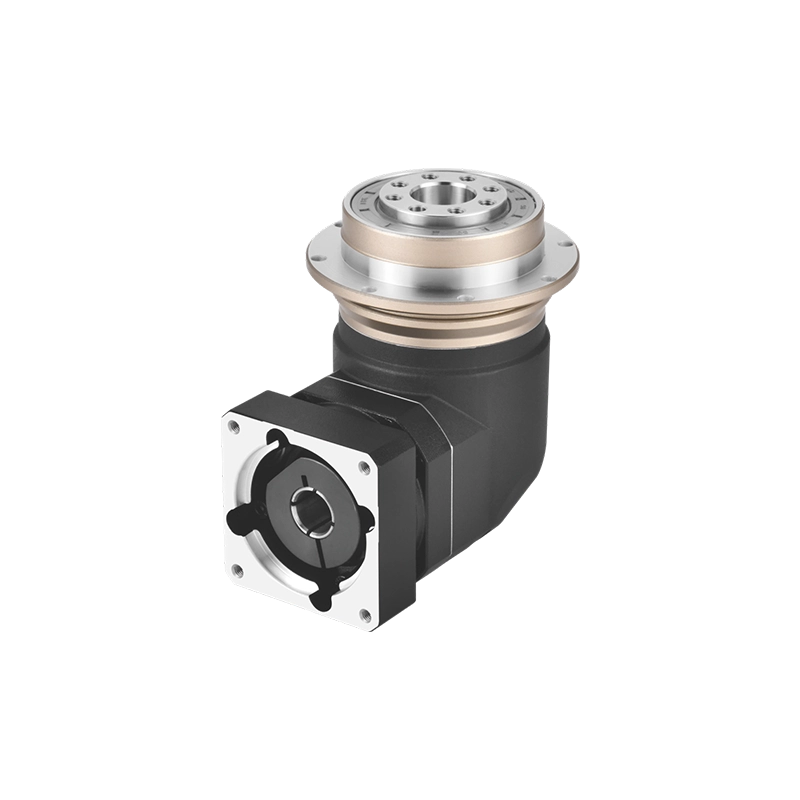
High Speed Gearbox Selection: Heat, Efficiency, and Bearing Considerations
In modern high-speed industrial automation, high-dynamic servo motors regularly operate at input speeds exceeding 3,000 RPM, with peak burst speeds reaching 6,000 RPM or higher. While matching output torque and reduction ratio is standard engineering practice, selecting a high speed gearbox introduces physical challenges that standard torque-based selection methods often fail to address. At high input velocities, thermal dissipation, bearing velocity limits (DN factor), viscous shear in lubricants, and housing heat rejection become the primary limiting factors governing continuous operational reliability.
When a precision gear reducer is subjected to continuous high rotational speeds, mechanical power loss turns directly into thermal energy. If heat accumulation outpaces thermal dissipation, internal temperatures surge beyond allowable limits. This leads to accelerated lubricant degradation, premature seal hardening, loss of gear mesh tooth stiffness, and severe thermal expansion that ruins backlash settings. For machine builders and system integrators designing high-duty cycle equipment, selecting a high speed planetary gearbox requires an engineering evaluation that balances mechanical strength with thermal equilibrium.
This technical guide details how high input speed fundamentally alters gear reducer physics, outlines key thermal and mechanical selection checks, highlights common engineering pitfalls, and presents a comprehensive RFQ checklist for specifying high-speed motion control solutions.
What High Input Speed Changes in Gearbox Physics
Operating a gear reducer at high rotational velocity changes internal dynamics from static torque loading to thermal-mechanical fluid dynamics. A standard high speed reduction gearbox experiences loss mechanisms that scale non-linearly with input speed n1. Understanding these internal loss mechanics is essential for sizing high-rpm gear assemblies.
1. Non-Linear Thermal Power Losses
Total power loss in a planetary gearbox (Ploss) is the sum of load-dependent losses (Pload) and load-independent (no-load) losses (P0):
Ploss = Pload + P0
- Load-Dependent Losses (Pload): Arise primarily from gear tooth sliding friction and rolling friction under contact load. While load loss scales linearly with output torque, higher sliding speeds across the gear mesh tooth profile amplify local flash temperatures at contact points.
- No-Load Losses (P0): Scale dramatically with input velocity n1. These include oil churning losses, gear windage losses in air-grease mixtures, bearing seal drag, and rolling friction of high-speed planet bearings. In high-speed continuous operations, no-load losses can exceed load-dependent friction losses, causing the gearbox to heat up even under minimal external load.
2. Centrifugal Displacement of Lubricant
At high rotational speeds, centrifugal forces drive semi-fluid grease or gear oil outward toward the internal ring gear housing, pushing lubricant away from high-speed sun gear contacts and planet needle bearings. Without continuous lubricant replenishment, gear teeth experience boundary lubrication regimes, resulting in micro-pitting, elevated noise levels, and rapid friction spikes.
3. Bearing Velocity Limits (DN Factor)
Input shaft bearings and sun gear support bearings must withstand extreme rotational speeds. Bearing speed capacity is governed by the DN factor, defined as:
DN = dm × n1
where dm is the bearing pitch diameter in millimeters and n1 is the input speed in RPM. Exceeding the maximum DN threshold generates excessive friction inside bearing raceways, leading to cage deformation, thermal runaway, and premature cage failure.
4. Differential Thermal Expansion and Backlash Drift
As the internal temperature of a high-speed gearbox rises, different components expand at unequal rates. Sun gears made of case-hardened alloy steel expand faster than external aluminum or steel housing structures cooled by ambient convection. This thermal differential alters tooth engagement geometry, reduces internal backlash clearance below designed tolerances, and can cause gear mesh binding if initial backlash is set too tight.
Key Selection Checks for High Speed Gearboxes
When specifying high speed gearboxes for automated packaging equipment, rotary indexing systems, or high-speed pick-and-place robotics, machine builders must evaluate five critical performance parameters beyond nominal output torque.
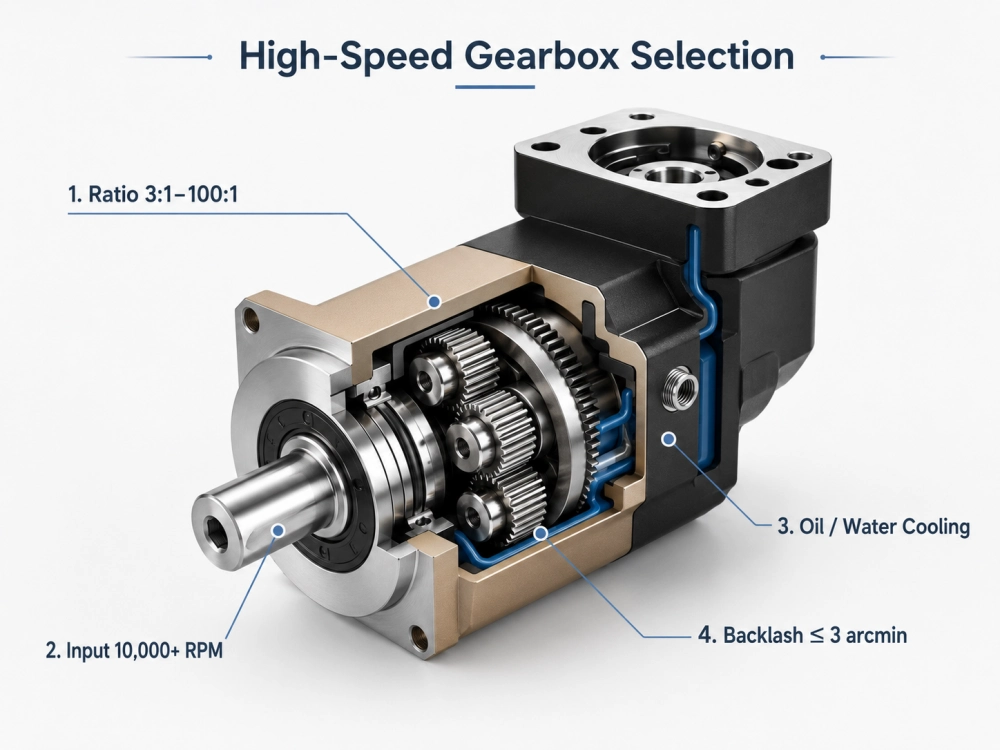
1. Continuous Input Speed (n1N) vs. Maximum Input Speed (n1Max)
Gearbox datasheets specify two distinct speed limits that engineers must carefully distinguish:
- Nominal Input Speed (n1N): The maximum continuous input speed at which the gearbox can operate indefinitely under standard ambient conditions (20°C) without exceeding its maximum thermal equilibrium temperature (Tmax, typically 90°C).
- Maximum Input Speed (n1Max): The absolute peak speed allowable during brief acceleration or deceleration spikes (intermittent duty). Operating continuously near n1Max will cause thermal failure within hours.
2. Thermal Limit Verification and Duty Cycle Analysis
Thermal power capacity (Pth) represents the actual mechanical power a gearbox can transmit continuously without overheating:
Pth = Pth,20°C × ft × stream × fh × fm
where ft is the ambient temperature correction factor, fh is the altitude/installation factor, and fm is the duty cycle factor. Engineers must evaluate duty cycle classifications according to ISO/DIN standards:
- Continuous Duty (S1): The motor runs uninterrupted for extended periods (>20 minutes). Thermal equilibrium is reached. Here, input speed must strictly stay below n1N, and actual continuous power must remain below Pth.
- Intermittent Duty (S5 / S8): Frequent start-stop operations with short run times and pause cycles. The effective mean input speed (n1m) and root-mean-square torque (T2RMS) govern selection rather than peak limits.
3. Lubrication Viscosity and Synthetic Formulations
High input speed applications require specialized lubrication strategies to balance film strength against churning losses:
- Synthetic Semi-Fluid Greases (NLGI 00 / 000): Preferred for sealed-for-life high-speed planetary gear reducers up to 4,000–5,000 RPM. Synthetic polyalphaolefin (PAO) or ester bases maintain stable viscosity across wide temperature ranges (-20°C to +120°C) while offering superior shear stability.
- Fully Synthetic Gear Oils: Required for heavy-duty, continuous-duty high speed reduction gearbox applications exceeding 6,000 RPM. Forced oil lubrication or optimized oil baths dissipate heat effectively while minimizing viscous fluid drag.
4. Low-Friction Seal Engineering
Traditional radial shaft oil seals (NBR/FKM) generate significant friction drag and heat at surface speeds above 10 m/s. High-speed gear reducers utilize specialized low-friction PTFE labyrinth seals or micro-grooved seal lips to reduce friction torque while preventing lubricant leakage under thermal pressure buildup.
5. Precision Helical Gearing vs. Spur Gearing
High speed applications demand smooth tooth mesh engagement. Precision helical planetary gears offer a higher contact ratio (>2.0) compared to straight spur gears (1.2–1.4). High contact ratios distribute load across multiple teeth simultaneously, reducing individual tooth impact force, lowering vibration, and decreasing operational acoustic noise by 6–10 dBA at speeds above 3,000 RPM.
Common Mistakes When Specifying High Speed Gearboxes
Selecting high speed gear reducers based on static load criteria alone frequently leads to field failures. Machine builders should avoid these four common engineering errors:
Mistake 1: Sizing Solely by Mechanical Output Torque
Selecting a gearbox based purely on the servo motor’s peak torque output without checking input speed thermal limits (Pth) is the leading cause of overheating. A gearbox may comfortably handle 100 Nm of mechanical torque at 1,000 RPM, but fail catastrophically at 4,000 RPM due to heat accumulation.
Mistake 2: Ignoring Mounting Orientation on Heat Convection
Gearboxes mounted vertically (input shaft facing up or down) experience different internal fluid levels and heat distributions than horizontally mounted units. In vertical mountings, upper bearings may suffer from oil starvation, and fluid churning increases as gears operate fully submerged. Failure to specify vertical orientation during procurement leads to improper grease fill levels and premature bearing destruction.
Mistake 3: Relying on Passive Convection in Enclosed Cabinets
High-speed gearboxes installed inside compact, non-ventilated machine frames or next to heat-generating servo motors cannot dissipate heat effectively through ambient air convection. Without active airflow, aluminum housing heat sink fins, or liquid cooling plates, ambient temperatures around the housing climb rapidly, reducing effective thermal capacity (Pth).
Mistake 4: Over-Specifying Zero-Backlash Without Thermal Margins
Demanding ultra-low backlash (<1 arcmin) in high-speed, continuous-duty applications can backfire. As internal components expand under continuous 5,000 RPM operation, zero clearance can convert into mechanical interference, destroying gear tooth flanks. For high-speed applications, specifying micro-backlash (3–5 arcmin) with controlled thermal clearance yields significantly longer service life.
Selecting Zhuochuang High-Speed Planetary Gearboxes
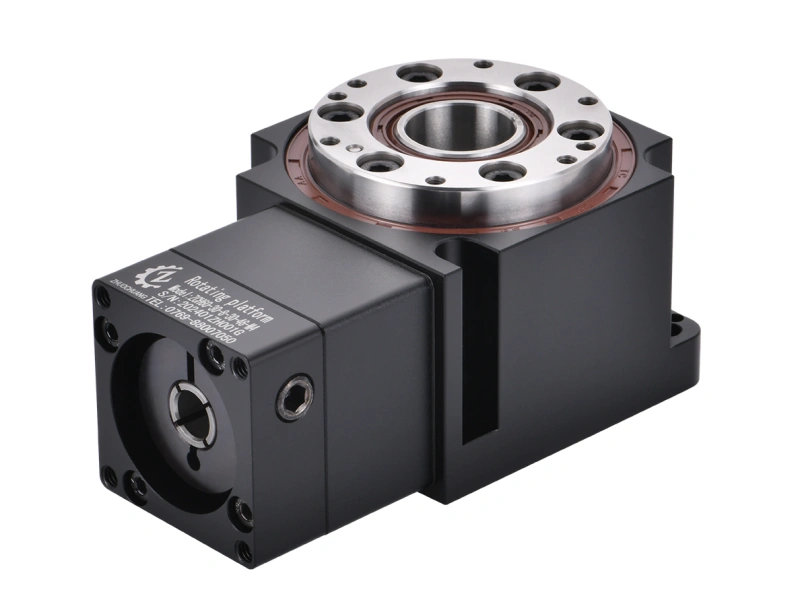
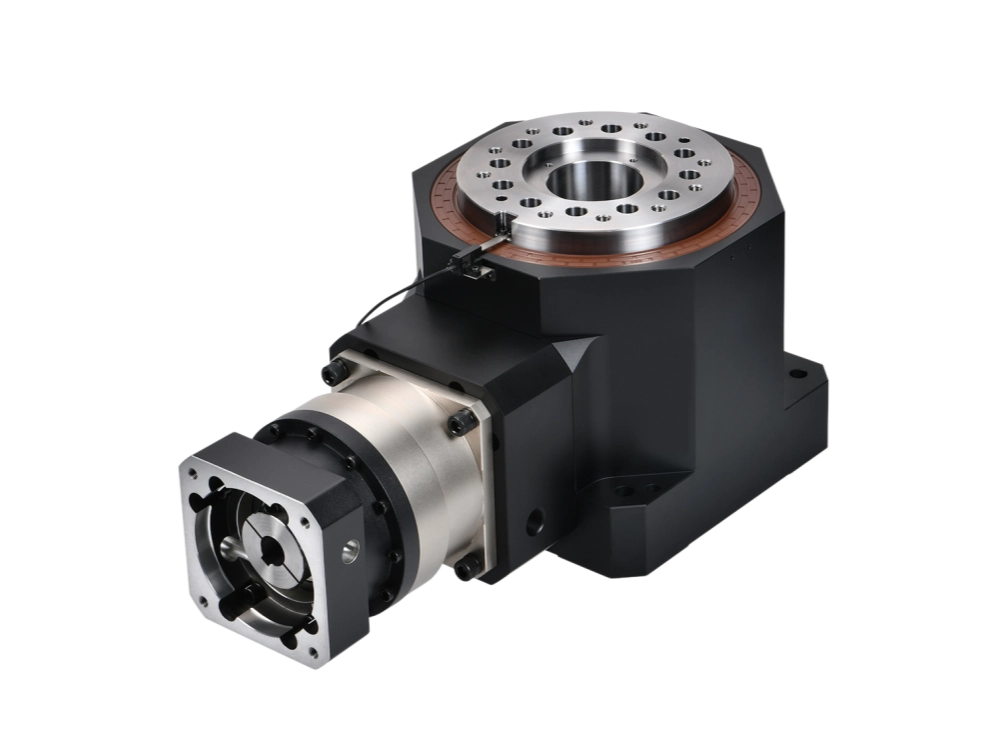
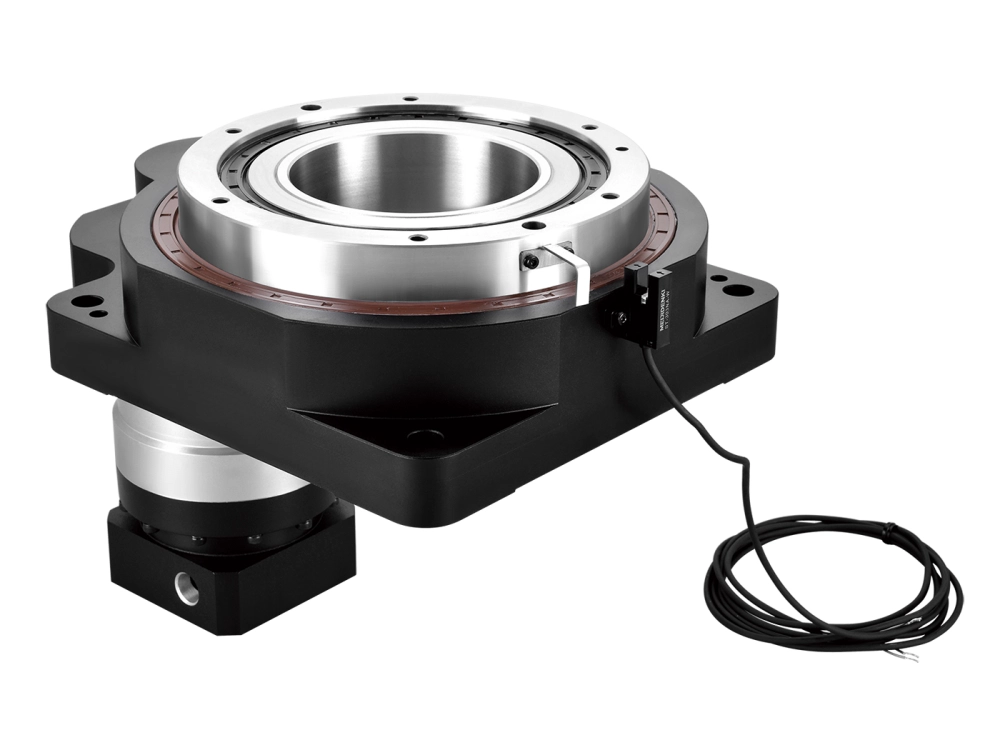
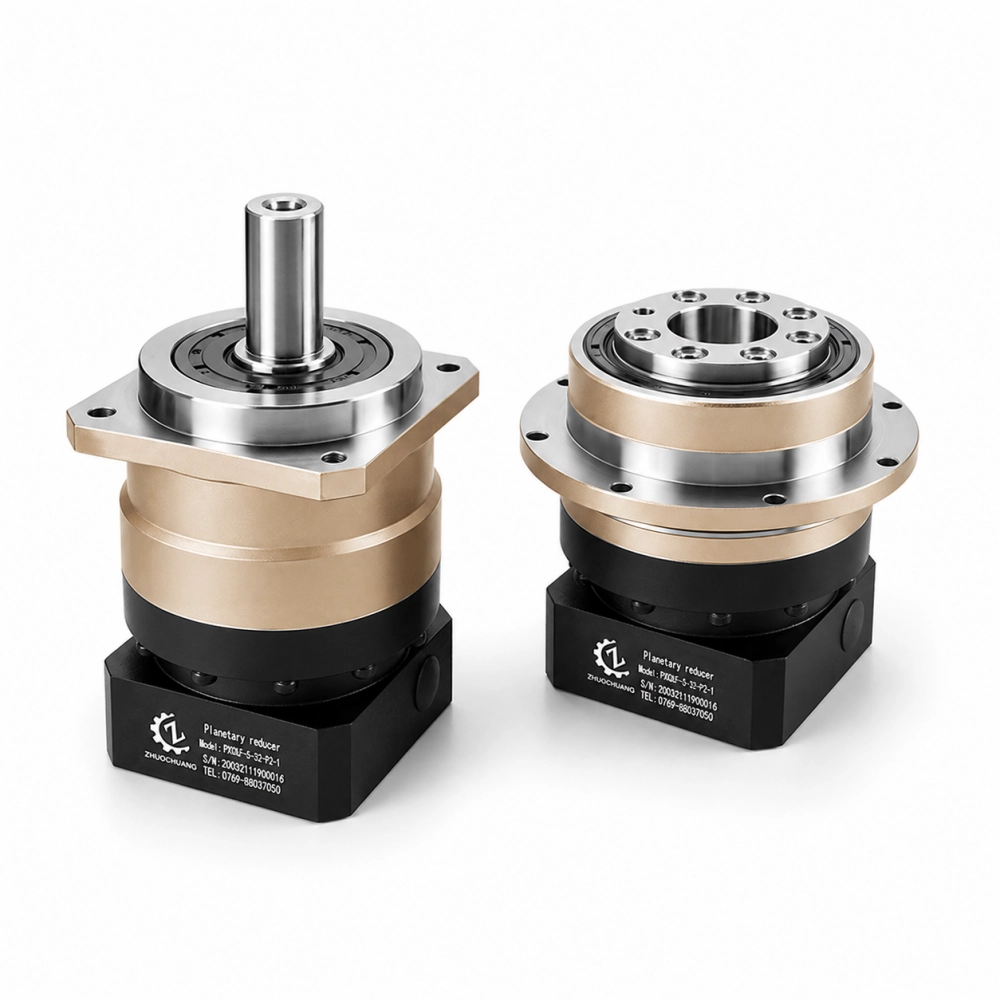
At Dongguan Zhuochuang Precision Machinery Co., Ltd., our Zhuochuang precision planetary gearbox series is specifically engineered to excel in high input speed, high-duty cycle automation applications. Through advanced metallurgical processing and computational fluid design, our gear reducers combine high power density with optimal thermal management.
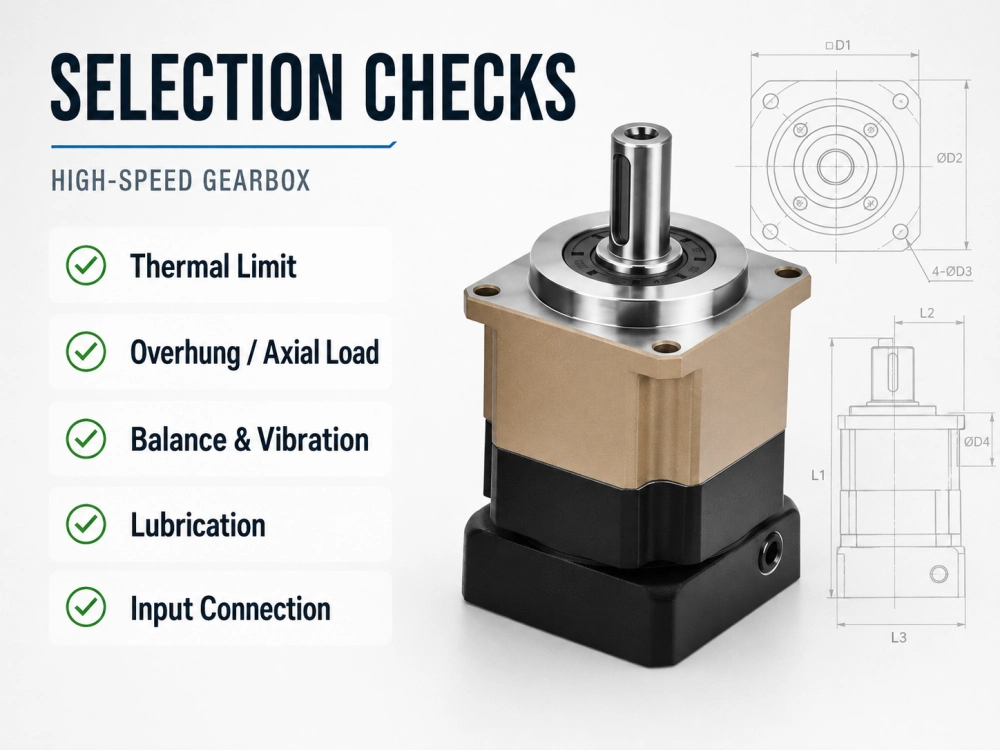
Key Architectural Features of Zhuochuang High-Speed Units
- Precision Helical Gear Profiles: Case-hardened 20CrMnTi alloy steel gears, ground to DIN 5/ISO 5 precision levels, deliver smooth mesh kinematics, minimum friction loss, and ultra-quiet operation at high RPM.
- Optimized Thermal Housing Design: High-tensile aluminum alloy housings with integrated cooling fins maximize thermal radiation surface area, maintaining housing equilibrium below 80°C during continuous high-speed runs.
- Pre-Loaded High-Speed Angular Contact Bearings: Heavy-duty input bearing arrangements withstand high radial and axial dynamics while keeping total runout below 0.005 mm.
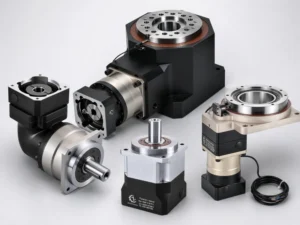
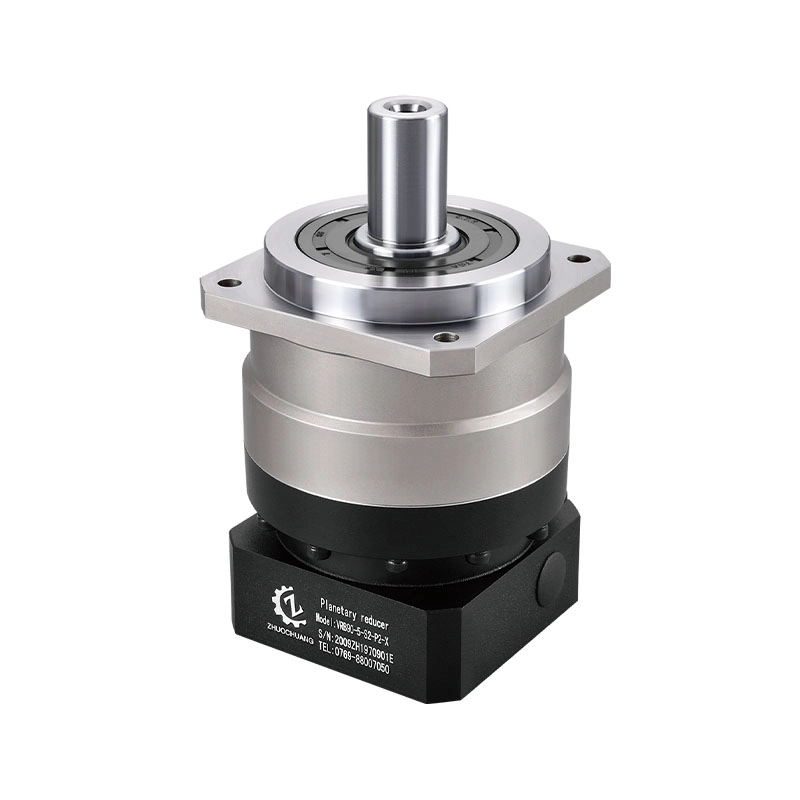
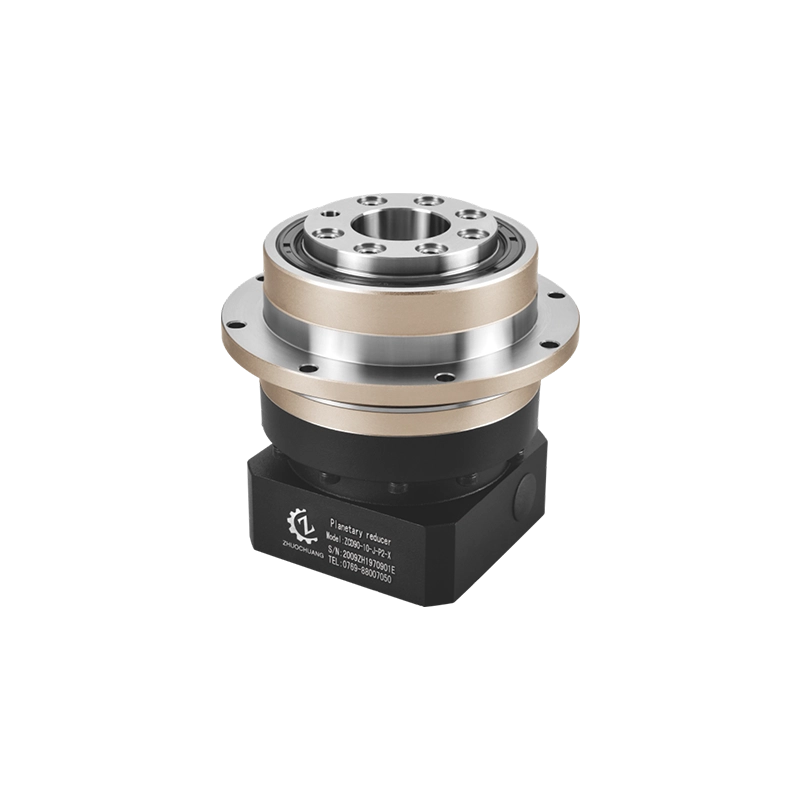
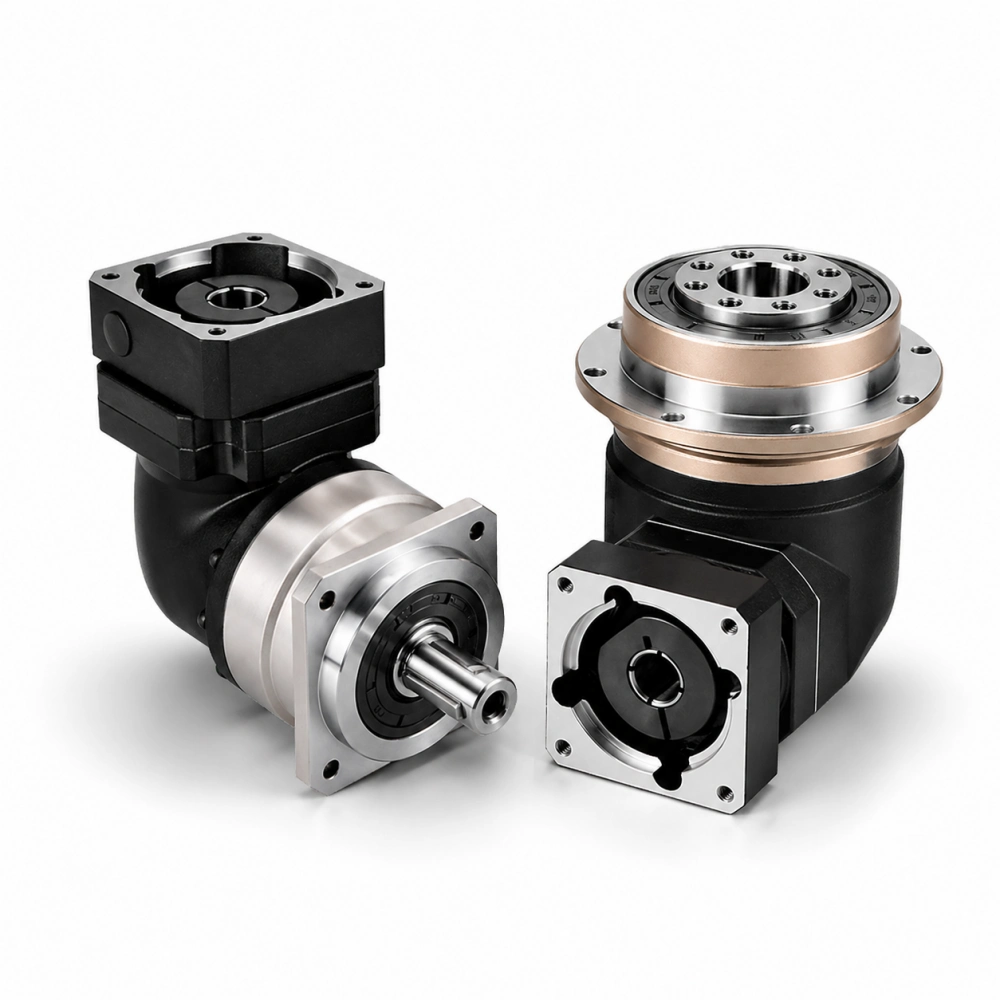
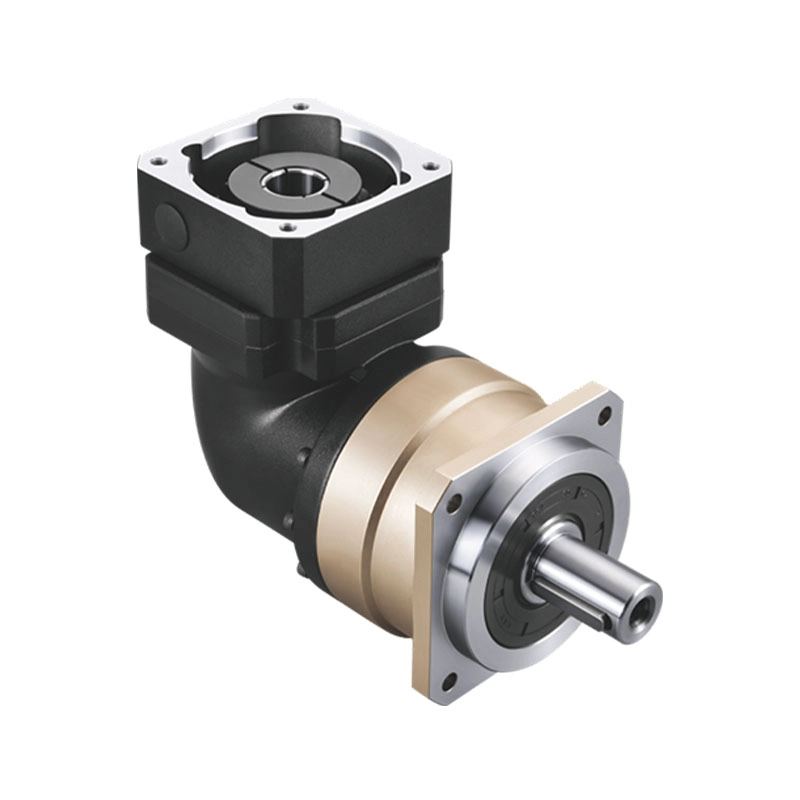
- Versatile Configuration Layouts: Available in both inline planetary gearbox configurations for coaxial drive trains and space-saving right angle planetary gearbox arrangements with spiral bevel input stages.
Product Selection Comparison Matrix
| Gearbox Series | Type / Layout | Max. Input Speed (n1Max) | Nominal Speed (n1N) | Backlash Range | Primary Application Fit |
|---|---|---|---|---|---|
| Zhuochuang P-Series | Inline Precision Planetary | 6,000 RPM | 3,500 RPM | ≤ 3 arcmin | High-speed delta robotics, dynamic servo feed drives, flying shears |
| Zhuochuang H-Series | Heavy-Duty Inline Planetary | 5,000 RPM | 3,000 RPM | ≤ 5 arcmin | Continuous material handling, high-speed gantry cranes, packaging equipment |
| Zhuochuang R-Series | Right-Angle Spiral Bevel Planetary | 5,000 RPM | 2,800 RPM | ≤ 4 arcmin | Compact machine layouts, rotary indexing, high-speed sorting conveyors |
RFQ Checklist for High Speed Gearbox Procurement
To ensure rapid, accurate engineering evaluation and quote preparation, machine builders should provide comprehensive application data when requesting a custom or standard high speed planetary gearbox quote.
Engineering Data Submission Checklist
| Selection Category | Required Engineering Parameter | Why It Matters for High-Speed Selection |
|---|---|---|
| Motor Specifications | Motor brand, exact model number, shaft diameter, pilot diameter, bolt circle (PCD) | Ensures precise input adapter flange machining and dynamic balanced shaft coupling fit. |
| Speed & Torque Profile | Nominal input speed (n1), maximum peak speed (n1Max), continuous torque (T2N), acceleration torque (T2B) | Determines mechanical safety margins and verifies thermal dissipation threshold (Pth). |
| Duty Cycle & Motion Profile | Continuous (S1) or Intermittent (S5), run time vs. dwell time, cycles per hour | Allows calculation of root-mean-square torque (T2RMS) and equilibrium operating temperature. |
| Precision & Load Requirements | Target backlash (arcmin), radial load (Fr2), axial load (Fa2), load application distance | Guides internal bearing selection (deep groove ball vs. angular contact vs. tapered roller bearings). |
| Environmental Conditions | Ambient temperature (°C), enclosure airflow, mounting angle (horizontal vs. vertical), IP protection rating | Dictates special grease selection, low-friction seal selection, and custom surface heat sink options. |
Ready to optimize your high-speed drive system? Contact our technical engineering team directly to submit your motor model, operating duty cycle, and dimensional constraints. We provide complete 2D/3D CAD models and detailed thermal sizing calculations within 24 hours. Visit our Zhuochuang Contact Page or submit a Request for Quote today.
Frequently Asked Questions (FAQ)
1. What is considered a high speed gearbox in industrial servo automation?
In servo automation, a high speed gearbox typically refers to a gear reducer designed to operate continuously at motor input speeds of 3,000 RPM to 6,000+ RPM. Unlike standard gearboxes that operate at low, steady speeds, high-speed units feature specialized thermal dissipation housings, low-friction synthetic lubricants, dynamic balanced couplings, and precision bearings optimized for high DN velocity limits.
2. Why does my high speed planetary gearbox get hot even when running with no load?
No-load heating in high-speed planetary gearboxes is caused by no-load power losses (P0), primarily oil/grease churning losses, air-windage friction, and seal lip drag. As input velocity n1 increases, these fluid dynamics losses rise rapidly, generating heat even when no output torque is being transmitted. Ensure the input speed does not exceed the nominal continuous rating (n1N).
3. How do I calculate the required gear ratio for a high-speed servo application?
The gear reduction ratio i is calculated by dividing the motor input speed n1 by the required machine output speed n2 (i = n1 / n2). In high-speed dynamic applications, engineers must also verify that the inertia ratio between the reflected load inertia and motor rotor inertia stays within recommended stability limits (ideally < 5:1 for high-speed dynamic response).
4. Can I run a standard planetary gear reducer at 5,000 RPM continuous input speed?
No. Standard planetary gearboxes are typically rated for intermittent peak speeds up to 4,000–5,000 RPM, but their continuous input speed (n1N) limit is often restricted to 2,000–3,000 RPM. Running a standard gearbox at 5,000 RPM continuously will cause thermal runaway, rapid grease breakdown, seal degradation, and mechanical seizure. Always select a dedicated high-speed planetary gearbox rated for continuous continuous-duty operations.
5. What is the difference between synthetic grease and oil lubrication in high-speed gearboxes?
Synthetic semi-fluid grease (NLGI 00/000) is ideal for maintenance-free, sealed-for-life planetary gearboxes operating up to 4,000–5,000 RPM, offering leak-proof operation and excellent cold-start protection. Fully synthetic gear oil is used for extreme high-speed or heavy continuous-duty applications above 5,000–6,000 RPM because fluid oil transfers heat away from gears and bearings significantly faster than grease.
Conclusion
Designing high-speed automated equipment requires looking beyond basic output torque and ratio calculations. High input rotational velocities transform gear reducer selection into a thermal and dynamic mechanical balancing act. By rigorously evaluating nominal vs. maximum input speeds, calculating thermal power ratings, selecting appropriate synthetic lubricants, and specifying precision helical gear architectures, machine builders can eliminate overheating risks and ensure long-term, maintenance-free production performance.
Whether you are engineering high-speed robotic pick-and-place systems, fast packaging machinery, or dynamic CNC feed mechanisms, Zhuochuang provides the engineering expertise and high-precision planetary gearbox solutions your equipment demands. Request a custom quote or engineering consultation today to get 2D/3D CAD models and expert sizing support tailored to your motor specifications.