
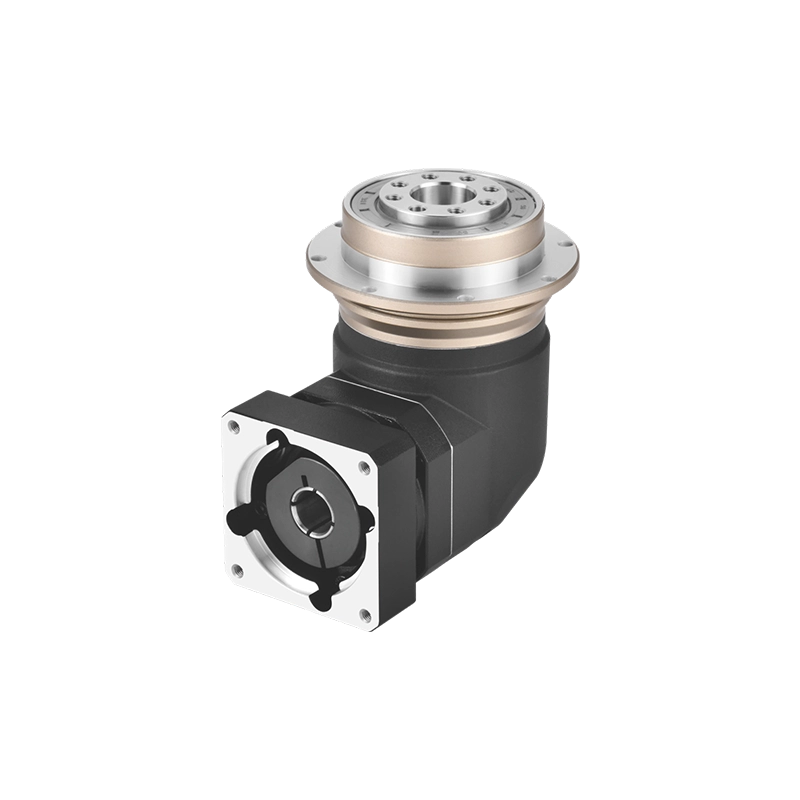
Shaft Mounted Speed Reducer vs Planetary Gearbox
A shaft mounted speed reducer is installed directly on the driven machine shaft instead of being fixed to a separate base and connected through an output coupling. This arrangement is widely used on conveyors, bucket elevators, mixers and other material-handling equipment because it can shorten the drive train and reduce alignment work.
That does not make it the automatic choice for every machine. A traditional shaft-mounted reducer is generally designed for industrial power transmission, while a precision planetary gearbox is commonly selected for servo-driven automation that needs compact dimensions, low backlash, high torsional stiffness and repeatable positioning.
This guide explains the difference from the mounting interface outward: how each reducer connects to the load, where a torque arm is required, which loads matter, and when a Zhuochuang planetary gearbox is—or is not—the appropriate solution.
What Is a Shaft Mounted Speed Reducer?
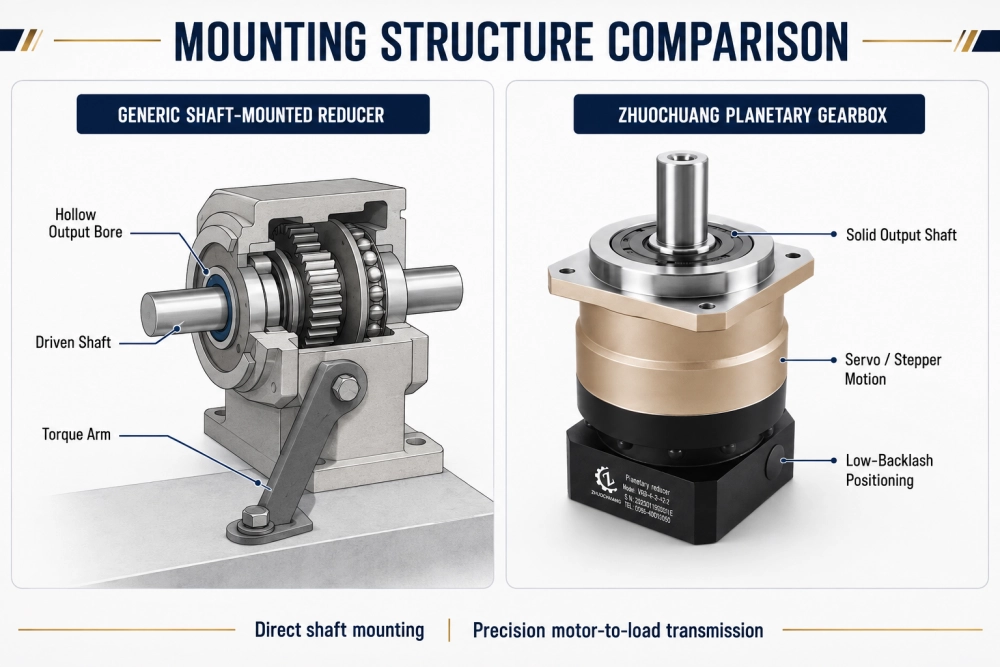
A shaft mounted speed reducer is a gear reducer with a hollow output bore that slides over the machine’s driven shaft. Depending on the design, the connection may use a keyed bore, tapered bushing, shrink disc or keyless locking system. The driven shaft supports the output connection, so a separate coupling between the reducer and that shaft is usually unnecessary.
The reducer housing must still be prevented from rotating. A torque arm connects the housing to the machine structure and reacts against the gearbox output torque. It should restrain housing rotation without creating harmful constraint or misalignment. SEW-EURODRIVE’s torque-arm guidance, for example, describes a jointed arrangement that supports reaction torque while compensating for mounting tolerances. Dodge Torque-Arm II is an official example of a shaft-mount helical reducer that installs directly on the driven shaft.
This product name describes the mounting arrangement, not one universal internal gear mechanism. Many conventional units use helical gearing, but shaft-mounted configurations can also be based on bevel-helical, worm or other industrial gear structures. Therefore, the words “shaft mounted” should not be treated as a synonym for “planetary.”
How the Mounting Structure Works
1. Hollow output bore
The reducer output contains a real bore sized for the customer’s driven shaft. The bore diameter, shaft tolerance, key size and engagement length must be confirmed together. A hole visible on the housing is not enough; the dimension drawing must identify it as the usable output bore.
2. Shaft attachment
A straight keyed bore is simple, but removal can become difficult if corrosion or fretting occurs. Tapered bushings improve concentric clamping and can simplify removal. Shrink discs and keyless locking systems can provide a backlash-free friction connection when specified and installed correctly. The right option depends on torque, reversing duty, shaft tolerance, service access and maintenance practice.
3. Torque arm
The torque arm prevents the reducer housing from counter-rotating. It is not a decorative bracket and should not be replaced by an arbitrary rigid plate. Its position, length, joint design and frame attachment affect reaction forces. The machine structure must be strong enough to accept those forces, especially during startup, braking, blockage or load reversal.
4. Motor input
The motor may drive the reducer through belts and sheaves, a coupling, a motor-mount adapter or an integrated gearmotor arrangement. Belt input makes ratio adjustment and motor placement flexible, but it adds belt tension and guarding requirements. Direct motor mounting reduces external transmission parts but requires the correct input adapter and motor interface.
Shaft Mounted Speed Reducer vs Planetary Gearbox
The most important difference is not simply the gear ratio. It is the job the reducer must perform and how it connects to the machine.
| Selection factor | Shaft-mounted speed reducer | Precision planetary gearbox |
|---|---|---|
| Typical purpose | General industrial power transmission | Precision servo and stepper motion |
| Load connection | Hollow bore fits directly over driven shaft | Solid shaft or output flange connects to the mechanism |
| Housing restraint | Usually requires a correctly installed torque arm | Housing or input flange is bolted to the machine structure |
| Common motor | AC induction motor or industrial gearmotor | Servo motor or stepper motor |
| Main priority | Durability, torque, duty cycle and easy drive installation | Low backlash, stiffness, compactness and motor matching |
| Typical application | Bulk conveyor, bucket elevator, mixer or screw conveyor | Robot, CNC axis, packaging machine or positioning system |
| Positioning duty | Usually not the primary design objective | Frequently selected for repeated controlled motion |
A planetary gearbox can be designed with a shaft-mounted or hollow-output interface, but that is not the standard form of every servo planetary gearbox. A buyer should never infer the mounting type from the word “planetary” alone. The output drawing must show how torque transfers to the load.
Where a Shaft-Mounted Reducer Fits Best
Bulk material conveyors
The arrangement is especially practical when the reducer can mount directly on the conveyor head pulley shaft. It eliminates a separate reducer-to-pulley coupling and can reduce the size of the fabricated drive base. Selection still has to account for starting torque, belt loading, shock, operating hours and the possibility of material blockage.
Bucket elevators and inclined conveyors
These applications may require a backstop to prevent reverse movement when the drive stops. Backstop direction must be verified before startup; installing it for the wrong direction can damage the drive. High starting load, frequent starts and loaded restart conditions also affect reducer service factor.
Screw conveyors and mixers
Direct shaft mounting can simplify the drive layout, but process loads may be less predictable than the nameplate power suggests. Packed material, cold starts, variable density and temporary jams can produce high peak torque. A reducer selected only from motor power may be undersized.
When it is not the best choice
A conventional shaft-mounted unit is usually not the first choice when an axis requires low backlash, rapid reversing, precise servo tuning or repeatable positioning. A large heavy-duty reducer may also be unsuitable where the machine needs a compact coaxial motor-and-gearbox package. In these cases, a precision planetary gearbox deserves separate evaluation.
When a Planetary Gearbox Is the Better Choice
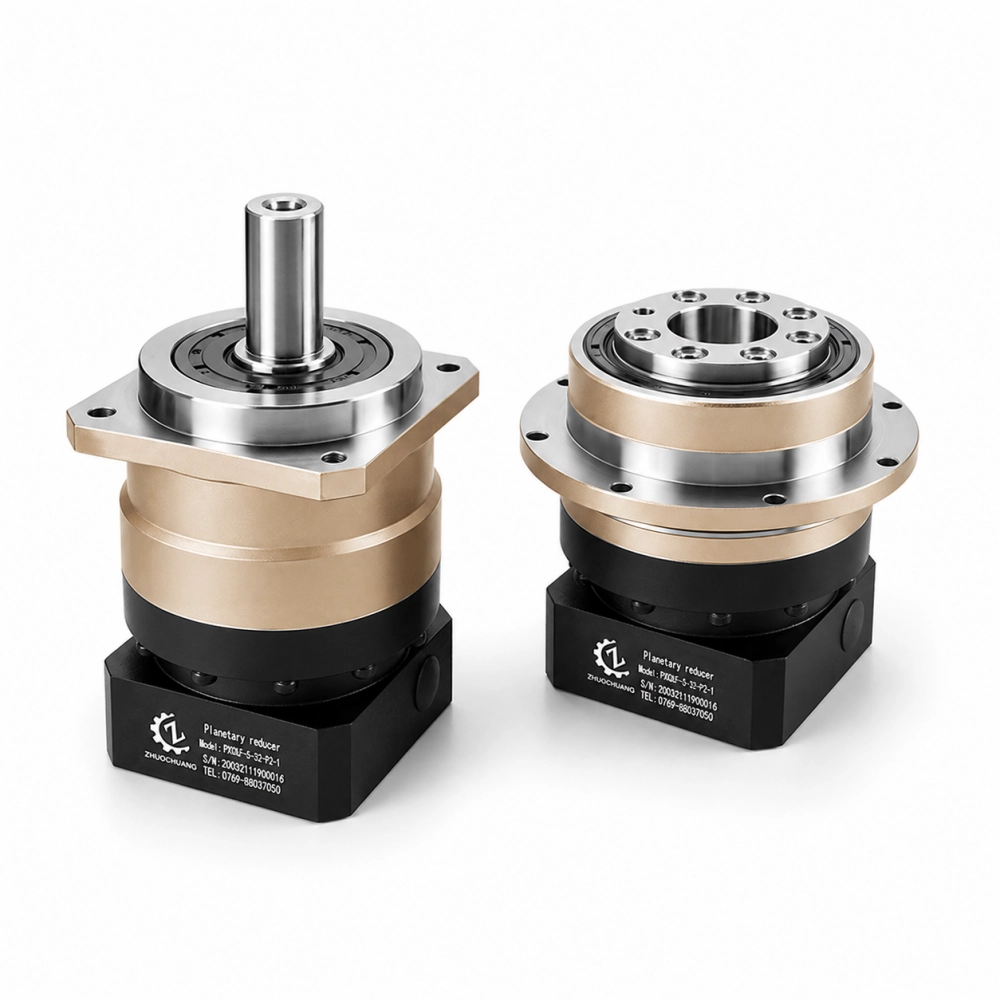
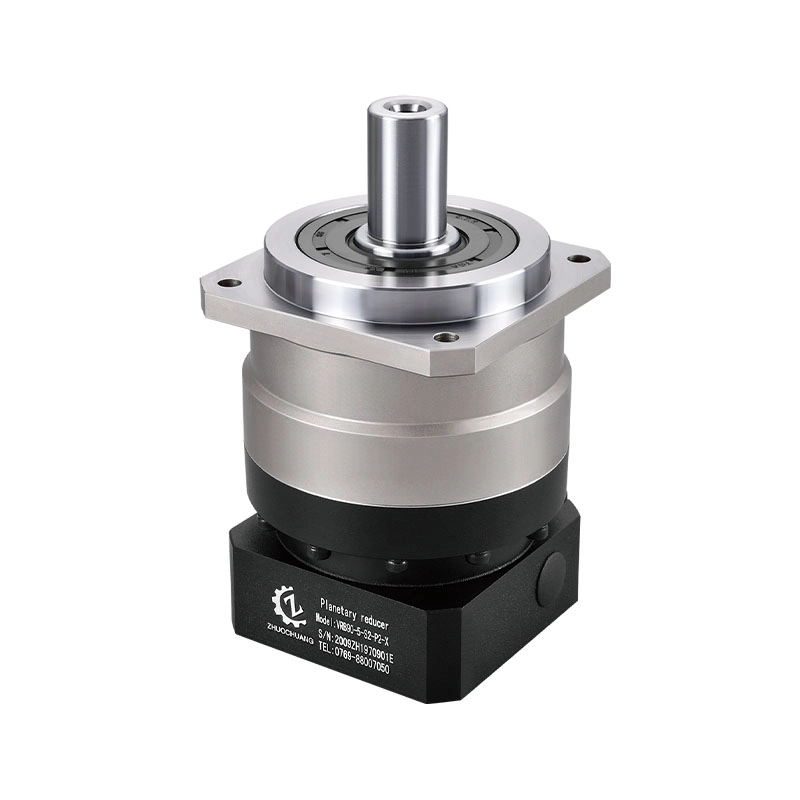
A planetary gearbox distributes torque through several planet gears around a central sun gear. This allows good torque density in a compact envelope. For automation equipment, the useful advantages can include low-backlash options, high torsional stiffness, efficient torque transmission and close integration with a servo or stepper motor.
Typical uses include:
- servo positioning axes that start, stop and reverse frequently;
- robotic joints and handling systems requiring compact transmission;
- CNC auxiliary axes and tool-changing mechanisms;
- packaging machines with synchronized motion;
- precision conveyors where indexing accuracy matters;
- inspection and assembly equipment with repeatable positioning.
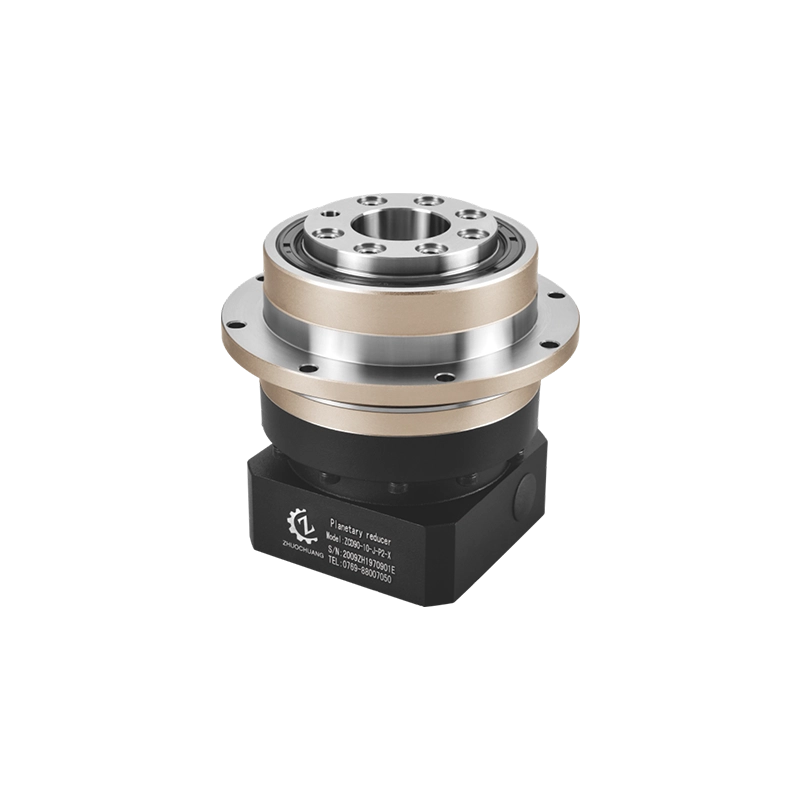
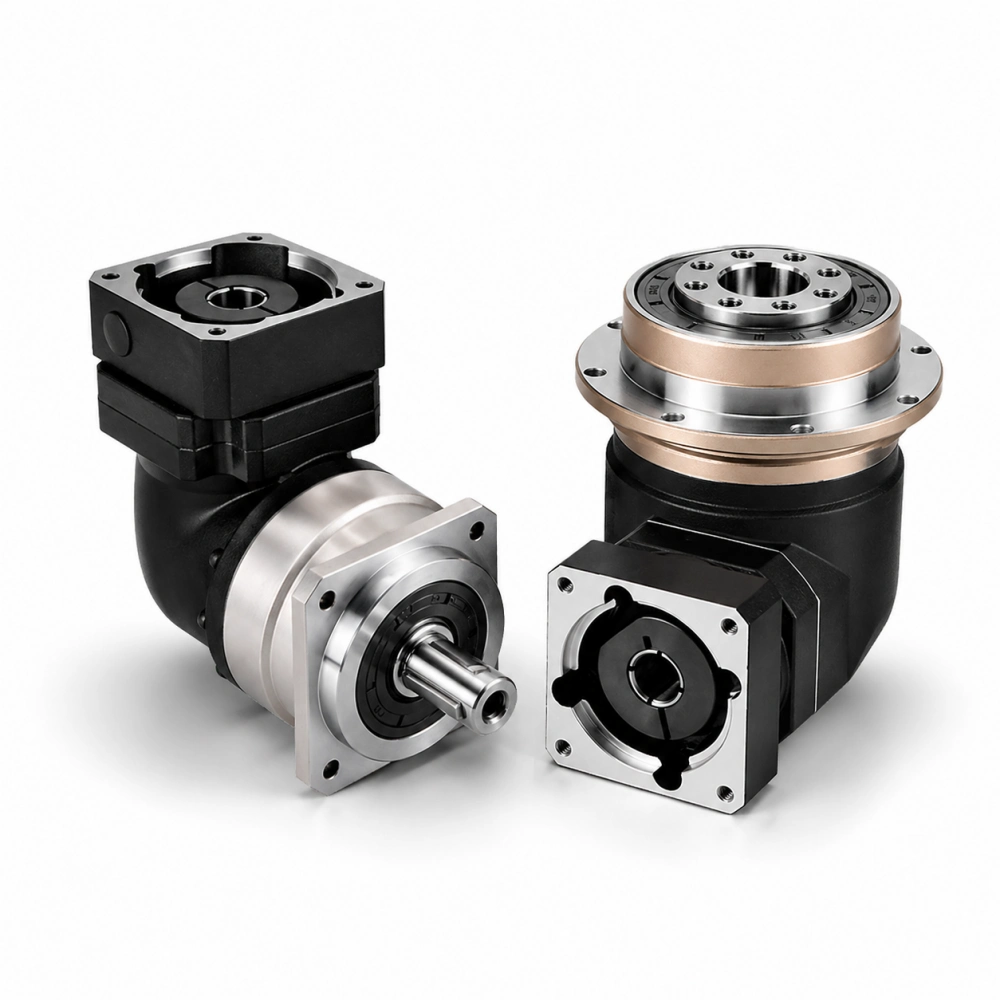
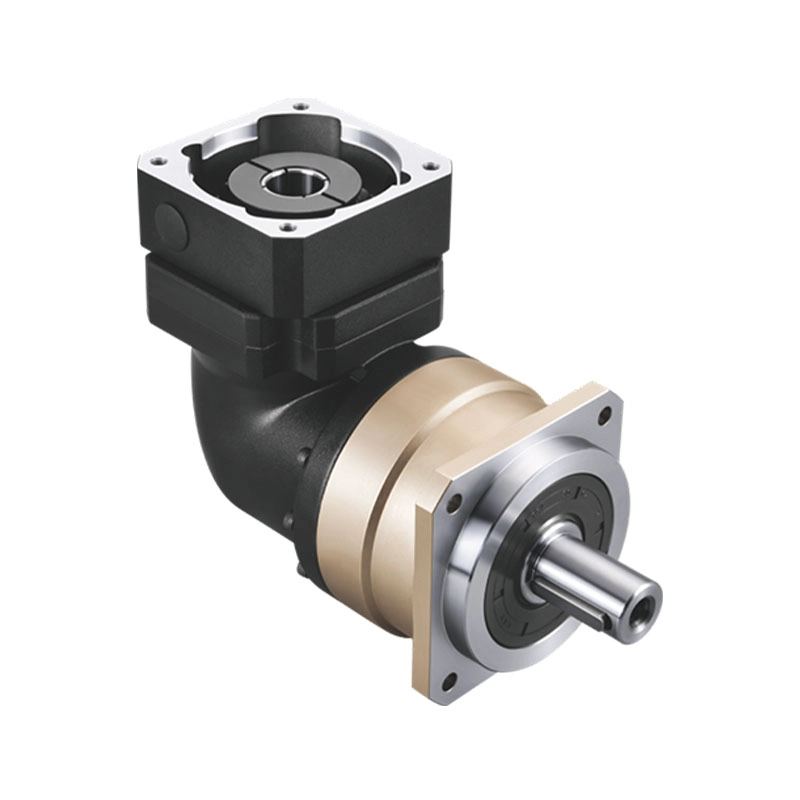
For a same-axis motor layout, review Zhuochuang’s inline planetary gearboxes. When installation length is limited, a right-angle planetary gearbox can place the motor beside the driven axis while retaining precision servo transmission.
Neither configuration should automatically be called a shaft-mounted reducer. The standard Zhuochuang units connect through defined shafts, flanges and motor adapters; they are not the traditional hollow-bore conveyor reducers described above.
Shaft Mounted Speed Reducer Selection Checklist
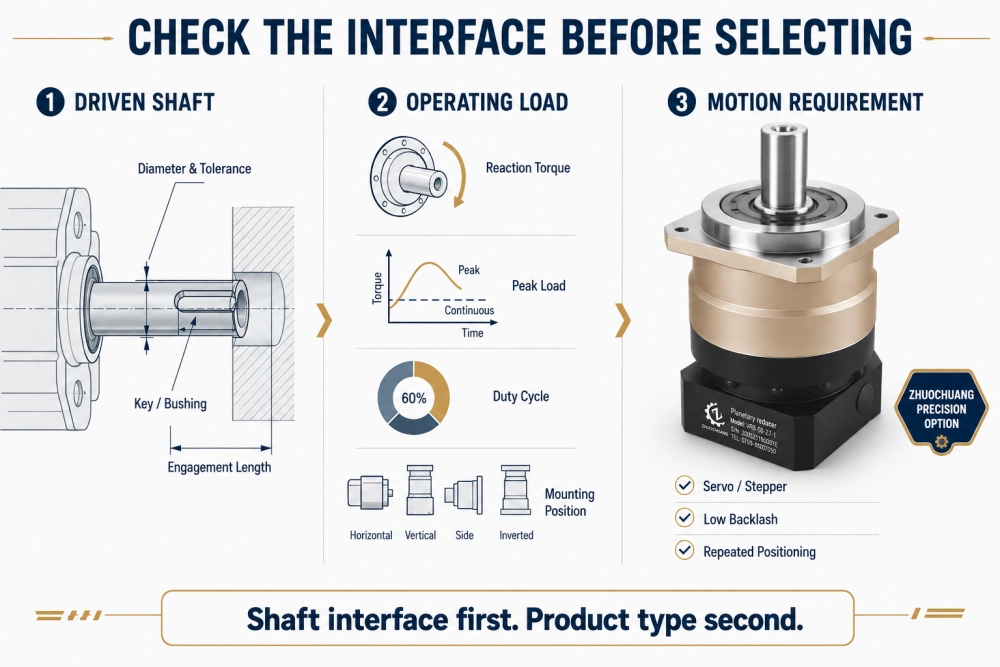
Driven-shaft dimensions
Provide the shaft diameter, tolerance, keyway, usable engagement length, shoulder position and end-retention method. Also confirm whether the machine shaft can support the reducer weight and operating reactions. A matching nominal diameter does not guarantee a correct mechanical fit.
Required output speed and ratio
Calculate the basic ratio from motor speed divided by required output speed. If belt input is used, include the sheave ratio as part of the total reduction. Do not choose a gearbox ratio without checking whether the final output speed meets the real production rate.
Continuous and peak torque
Calculate running torque from the load, then separately evaluate acceleration, starting, braking, blockage and shock conditions. Peak torque may control the mechanical size even when average operating torque is low.
Service factor and operating schedule
State the daily operating hours, starts per hour, load variation, ambient temperature and whether the machine can restart while loaded. A conveyor operating continuously in dust and heat requires a different service margin from an intermittently used indoor machine.
Torque-arm geometry
Show the available frame attachment point and the expected torque-arm direction on the installation drawing. Avoid a layout that rigidly over-constrains the reducer or transfers excessive bending into the driven shaft. Follow the reducer manufacturer’s installation instructions rather than designing the restraint from appearance alone.
Radial loads and belt tension
If the motor drives the reducer through belts, input bearings must handle the sheave load. If the output arrangement also carries external loads, confirm the permitted radial and axial forces at the specified position. Torque capacity and bearing capacity are separate checks.
Lubrication and mounting orientation
Oil level, breather position and drain location depend on orientation. A reducer approved for horizontal mounting may require different lubrication arrangements in vertical or inclined positions. Incorrect oil level can cause overheating, leakage or bearing damage.
Backstop and safety guarding
Confirm whether reverse rotation creates a safety or process risk. If a backstop is used, specify the required running direction. Guards may be required around rotating shafts, couplings, belts and sheaves. Safety requirements should be resolved in the machine design, not after commissioning.
Removal and maintenance access
Leave room to remove bushings, fasteners, guards and the reducer. Corrosion protection and correct assembly compounds can matter in humid or washdown environments. A compact installation that cannot be dismantled safely will create unnecessary downtime later.
Common Selection Mistakes
- Choosing only by motor power: identical motor power can produce different shaft torque depending on speed, ratio and load cycle.
- Ignoring reaction torque: the housing needs a properly designed restraint; the driven shaft alone does not stop housing rotation.
- Confusing hollow bore with through-axis routing: the bore is primarily a torque connection to the driven shaft, not necessarily a passage for cables or tubing.
- Using nominal shaft diameter alone: tolerance, key, engagement length and retention also control the fit.
- Overlooking loaded starts: conveyors and mixers may require much more torque during startup or a jam than during steady running.
- Assuming every gearbox suits servo positioning: low backlash and torsional stiffness must be specified and verified.
- Ignoring removal: a reducer that cannot be removed without damaging the shaft increases future maintenance cost.
Where Zhuochuang Fits—and Where It Does Not
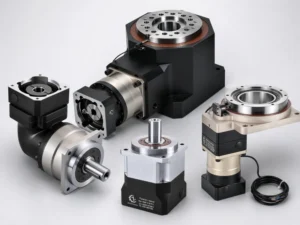
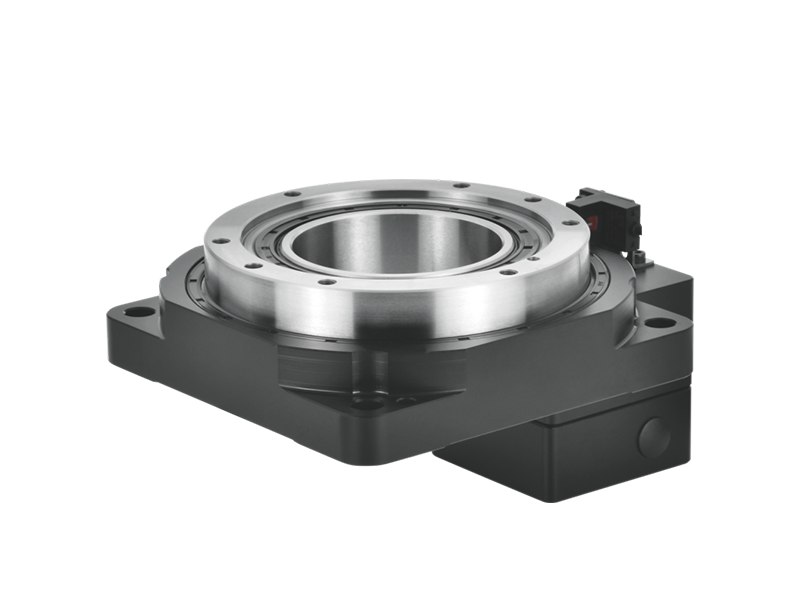
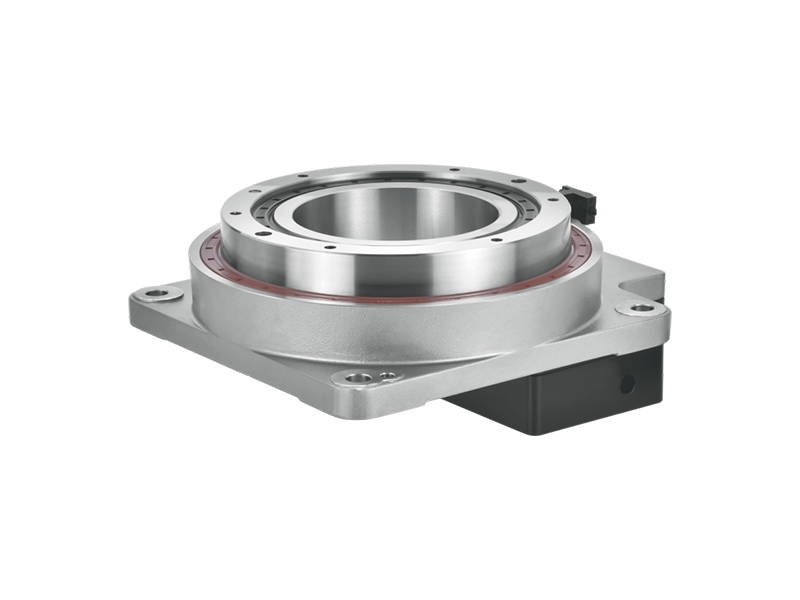
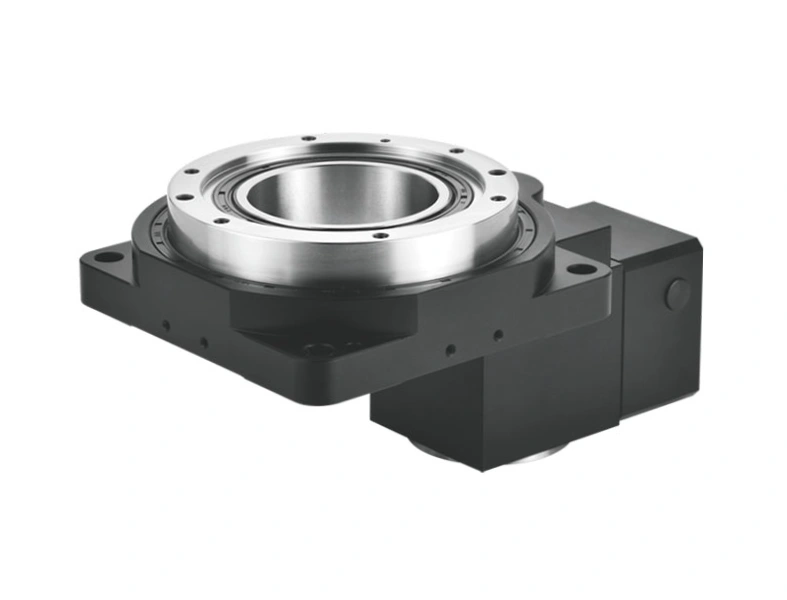
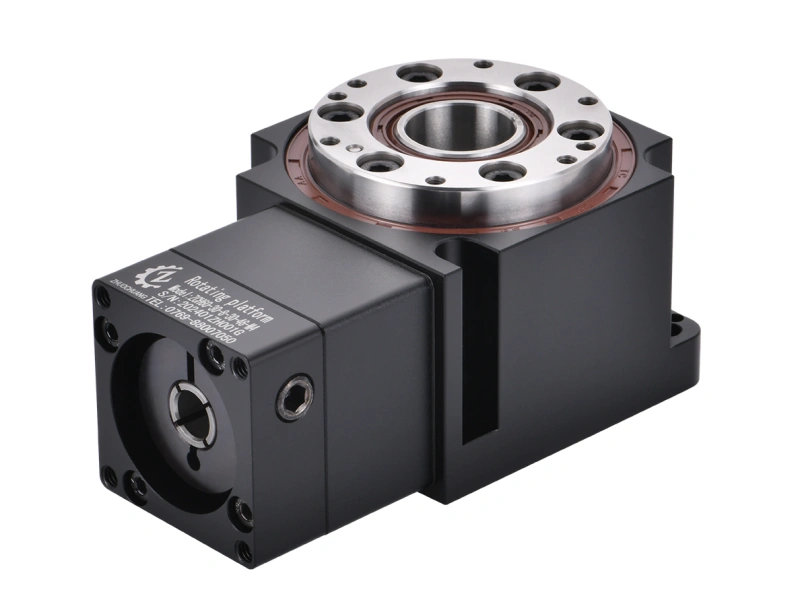
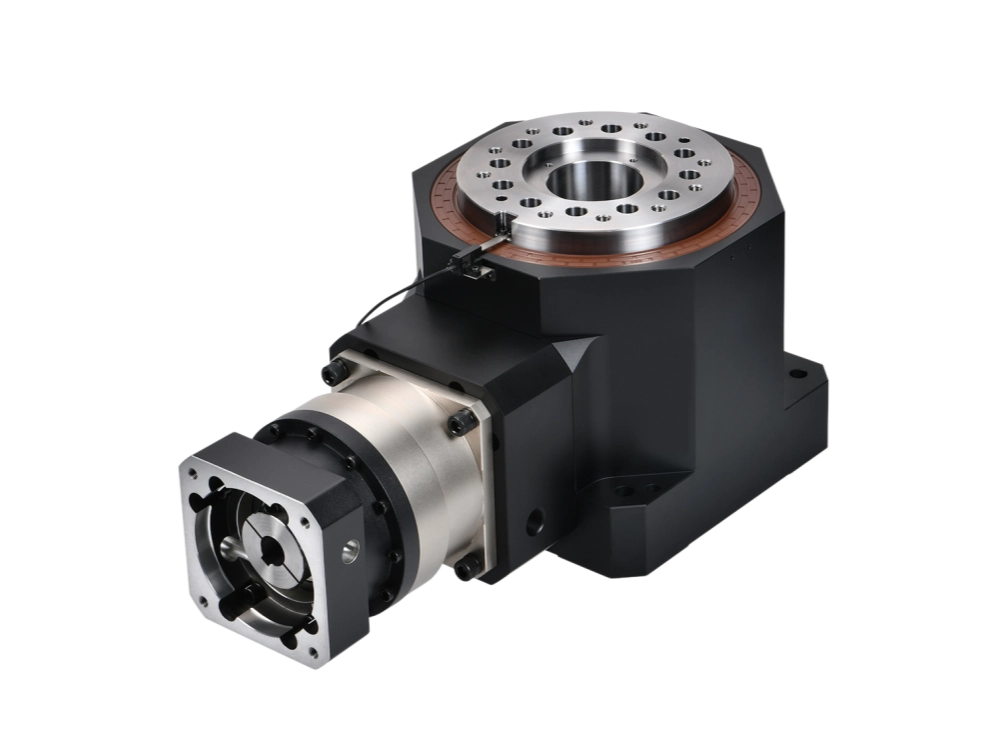
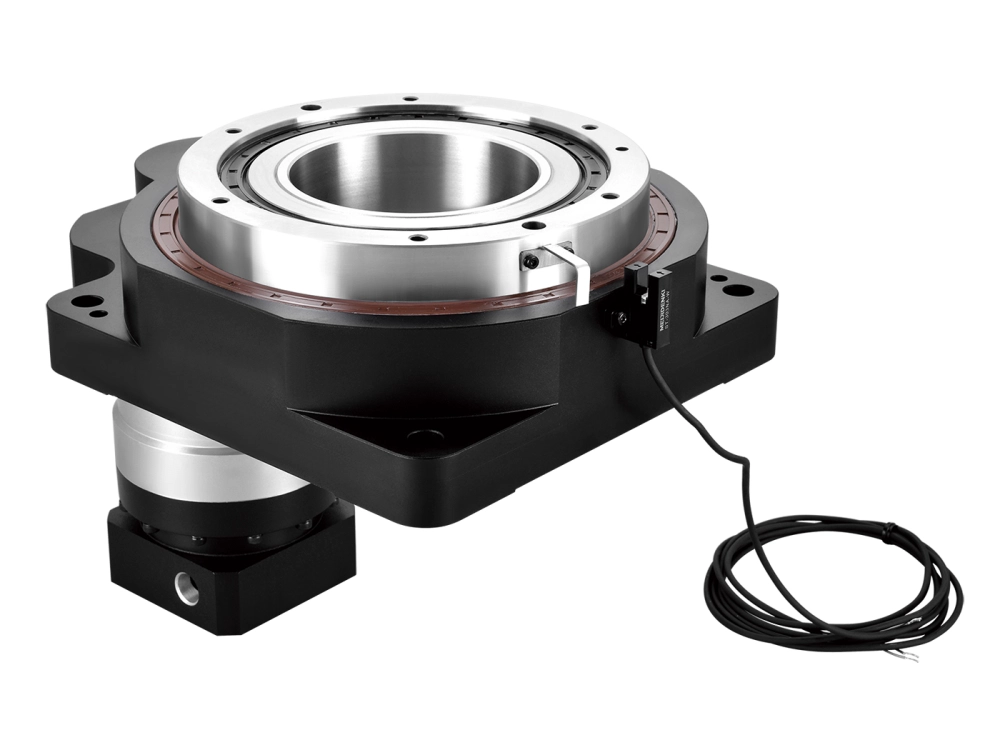
Dongguan Zhuochuang Precision Machinery Co., Ltd. manufactures precision planetary gearboxes and hollow rotary tables for servo-driven automation, robotics, CNC equipment, packaging machinery and positioning systems.
Zhuochuang’s standard VRB, ZCD, ZCF, VRBR and ZCDR product families should not be presented as traditional shaft-mounted conveyor reducers unless a specific engineered version and drawing confirm that interface. We do not recommend sending an inquiry for a conventional hollow-bore helical conveyor reducer and expecting a standard servo planetary model to be interchangeable.
However, a machine designer comparing the two layouts may discover that the real application is not a bulk conveyor drive at all. If the axis uses a servo or stepper motor and needs compact size, controlled acceleration, low backlash, stiffness or repeatable positioning, a Zhuochuang precision planetary gearbox may be the more suitable direction.
If the machine genuinely requires the reducer to slide over a driven shaft, state that requirement clearly. If it instead needs a motor-mounted planetary gearbox with a solid shaft or flange output, send the motor model, required ratio, torque, backlash, mounting drawing, duty cycle and quantity through the Zhuochuang contact page.
For a broader comparison of transmission designs, read Types of Gear Reducers and When Planetary Designs Fit Best. That article compares internal reducer families; this guide is intentionally limited to the mounting and application boundary between shaft-mounted industrial drives and precision planetary gearboxes.
Frequently Asked Questions
What is a shaft mounted speed reducer?
It is a reducer with a hollow output bore that mounts directly on the driven machine shaft. A bushing, key or locking device transfers torque, while a torque arm normally prevents the housing from rotating.
Is a shaft-mounted reducer always a hollow-shaft gearbox?
It normally has a hollow output bore for the driven shaft, but “hollow shaft” can describe several different product structures. Confirm the bore function, attachment method and drawing rather than relying on the name alone.
Does a shaft-mounted reducer need a torque arm?
Most traditional shaft-mounted arrangements require a torque arm or an approved equivalent housing restraint. Its job is to react against output torque while avoiding harmful constraint. Always follow the specific manufacturer’s installation instructions.
Is a shaft mounted speed reducer a planetary gearbox?
Not necessarily. Many traditional units use helical gearing. “Shaft mounted” describes how the reducer connects to the driven shaft, while “planetary” describes the internal gear mechanism. A planetary gearbox can have different output and mounting designs.
When should I choose a planetary gearbox instead?
Consider a precision planetary gearbox when the machine uses a servo or stepper motor and needs compact dimensions, high torque density, low backlash, torsional stiffness, frequent reversing or repeatable positioning.
Does Zhuochuang manufacture shaft-mounted speed reducers?
Zhuochuang’s published standard range focuses on precision planetary gearboxes and hollow rotary tables, not conventional shaft-mounted helical conveyor reducers. Submit the application drawing if you need an engineered interface assessment.
Final Selection Rule
Choose the mounting structure before comparing catalog torque numbers. For a bulk conveyor or general industrial shaft drive, a traditional shaft mounted speed reducer may offer the simplest installation. For servo-controlled automation that needs compact transmission and repeatable motion, a precision planetary gearbox is usually the more relevant product family.
The safest RFQ identifies the driven-shaft connection, motor, output speed, continuous and peak torque, duty cycle, mounting orientation and accuracy requirement. Those facts make the product category clear before price and model selection begin.