
Multistage Planetary Gearbox: 2-Stage and 3-Stage Selection Guide
A multistage planetary gearbox is not selected because “more stages” sounds stronger. Stage count is a consequence of the required ratio, torque, efficiency, backlash target, and available installation space.
If a single-stage planetary gearbox can provide the required ratio and torque, it is usually the simplest and most efficient choice. When the required ratio becomes too high for one stage, engineers move to a 2-stage planetary gearbox. When the ratio is even higher, a 3-stage design may be required — but it brings extra length, efficiency loss, heat, and backlash considerations.
This article explains how multistage planetary gearboxes work, how 2-stage and 3-stage ratios are calculated, what happens to efficiency across stages, how backlash accumulates, and how to decide whether a single-stage, two-stage, or three-stage configuration is the right direction for a servo automation system.
The Core Idea: Stage Count Follows Ratio
A single planetary stage commonly covers ratios from about 3:1 to 10:1, depending on the gear geometry and product design. The basic fixed-ring planetary stage ratio is:
Stage ratio = Ring gear teeth ÷ Sun gear teeth + 1
For example, if the ring gear has 72 teeth and the sun gear has 18 teeth:
72 ÷ 18 + 1 = 5:1
The reason a single stage has a practical upper limit is geometry. To push the ratio higher, the ring gear must become much larger relative to the sun gear. At some point, the planet gears become too large, too close together, or mechanically compromised.
That is why stage count is not just a catalogue option. If the application needs 5:1, one stage may be enough. If it needs 25:1, a 2-stage planetary gearbox becomes necessary. If it needs 120:1 or higher, a 3-stage planetary gearbox may need to be considered.
Engineering note: Do not start by asking “Do I need two stages?” Start by asking “What total ratio does the machine require?” Stage count follows from that answer.
How a 2-Stage Planetary Gearbox Works
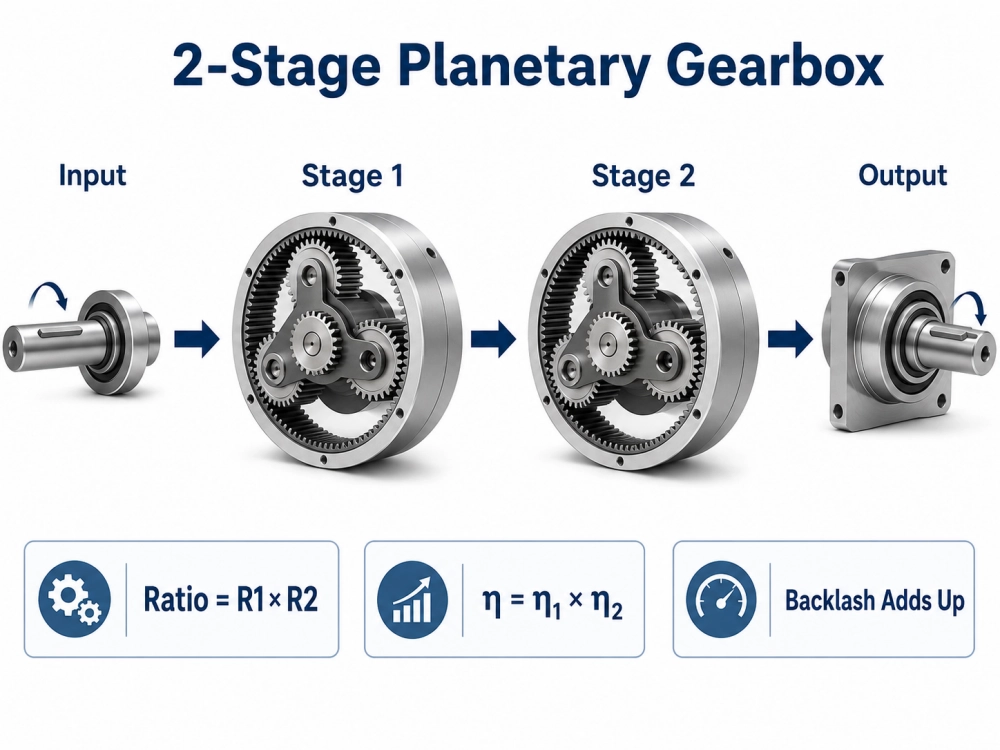
In a 2-stage planetary gearbox, two planetary gear sets are arranged in series. The output carrier of the first stage drives the sun gear of the second stage. The total ratio is the product of the two individual stage ratios.
Total ratio = Stage 1 ratio × Stage 2 ratio
Examples:
| Total Ratio | Stage 1 | Stage 2 | Comment |
|---|---|---|---|
| 20:1 | 4:1 | 5:1 | Balanced ratio split |
| 25:1 | 5:1 | 5:1 | Symmetric and common |
| 50:1 | 5:1 | 10:1 | High two-stage range |
| 56:1 | 7:1 | 8:1 | Used when a specific output speed is required |
The ratio split affects more than arithmetic. It influences torque distribution, bearing load, gear tooth stress, stage size, noise, heat, and service life.
For this reason, a good manufacturer does not simply multiply two random ratios. The internal stage ratio split should be selected according to the torque path, frame size, gear strength, and output requirements.
Why a 20:1 Ratio Usually Needs Two Stages
A 20:1 planetary gearbox is a useful example. Trying to achieve 20:1 in one planetary stage would require an unrealistic gear geometry. The sun gear would become too small, the ring gear too large, or the planet gear arrangement too difficult to package.
A better approach is to split the reduction across two stages:
4:1 × 5:1 = 20:1
or:
5:1 × 4:1 = 20:1
This gives the gearbox a more practical internal structure. Each stage handles part of the ratio, and the design can maintain better strength, stiffness, and manufacturability.
For servo automation, a 2-stage planetary gearbox is often used when the machine needs a medium-to-high ratio while still requiring compact size, low backlash, and good torsional stiffness.
Efficiency Across Multiple Stages
Efficiency is one of the biggest trade-offs in multistage planetary gearbox selection.
A high-quality planetary stage may have high efficiency at rated operating conditions. But when stages are connected in series, the efficiencies multiply.
Total efficiency = Stage 1 efficiency × Stage 2 efficiency × Stage 3 efficiency
Using 98% per stage as a simple example:
| Configuration | Efficiency Calculation | Approximate Overall Efficiency | Main Concern |
|---|---|---|---|
| Single stage | 0.98 | 98.0% | Highest efficiency |
| 2-stage | 0.98 × 0.98 | 96.0% | Moderate heat increase |
| 3-stage | 0.98 × 0.98 × 0.98 | 94.1% | More heat and longer housing |
This does not mean 3-stage gearboxes are bad. It means they must be selected for the right reason.
Efficiency loss becomes heat. In intermittent motion, heat may not be a serious problem. In continuous-duty applications, high cycle rates, or enclosed machinery, the thermal effect can become important.
Selection note: For a multistage gearbox, ask for overall efficiency of the assembled unit, not only the theoretical efficiency per stage.
Backlash Accumulation Across Stages
Backlash is one of the most important concerns in precision servo applications.
In a single-stage planetary gearbox, the output backlash comes mainly from gear tooth clearance, bearing play, and assembly tolerance within that stage.
In a multistage planetary gearbox, backlash contributions from multiple stages must be considered. The output backlash is not simply the same as one stage. It is affected by the stage layout and ratio reflection.
A simplified way to understand a 2-stage unit is:
Total output backlash ≈ Backlash of final stage + reflected backlash of earlier stage
For example, if both stages have 3 arcminutes of stage backlash and the second stage has a 5:1 ratio, the first-stage contribution is reduced when reflected to the output:
Output backlash ≈ 3 + 3 ÷ 5 = 3.6 arcminutes
This is why the final specification must be stated as output backlash, not “backlash per stage.”
For precision positioning, the machine only sees the output behavior. A catalogue value that describes only one internal stage may not be enough for accurate error budgeting.
When a 3-Stage Planetary Gearbox Is Needed
A 3-stage planetary gearbox is used when the required ratio is higher than a two-stage unit can reasonably provide.
Examples of three-stage ratio multiplication include:
5 × 5 × 5 = 125:1
4 × 5 × 8 = 160:1
5 × 7 × 8 = 280:1
A 3-stage configuration can be useful for slow-speed precision rotary motion, high-ratio servo axes, large positioning systems, and some indexing applications.
But three stages also bring clear trade-offs.
| Trade-Off | What It Means |
|---|---|
| Longer housing | More stages increase axial length and may affect machine layout. |
| Lower efficiency | Losses multiply across stages and create more heat. |
| More backlash sources | Output backlash must be confirmed as a complete assembly value. |
| Higher cost | More components, bearings, gears and assembly steps increase cost. |
| Thermal concern | Continuous-duty systems need careful heat and lubrication review. |
Three stages should not be used simply because a high ratio looks attractive. They should be used when the application truly requires that ratio and can accept the efficiency, size, and cost trade-offs.
Multistage Gearboxes in Servo Automation
In servo automation, a multistage planetary gearbox is not only a speed reducer. It is part of the motion control chain.
The gearbox affects:
- Motor speed range
- Output torque
- Load inertia matching
- Servo tuning stability
- Positioning accuracy
- Backlash behavior
- Heat generation
- Cycle performance
For a high-speed servo motor, the ratio must bring the output speed into the correct range while increasing usable torque. But if the ratio is too high, the system may become slower than necessary, and the motor may not operate in its best dynamic range.
This is why multistage selection should always connect the gearbox ratio to the actual motion profile, not only to the theoretical speed reduction.
Supplier Questions for a Multistage Planetary Gearbox
When discussing a multistage planetary gearbox with a supplier, do not ask only for ratio and price.
Ask for the complete unit data:
- Total gear ratio
- Overall efficiency at operating load
- Output backlash
- Rated continuous output torque
- Peak torque capacity
- Maximum input speed
- Thermal rating
- Service factor recommendation
- Motor adapter compatibility
- Output shaft or flange option
- Lubrication condition
- Installation direction
- Axial length and mounting size
For general gearing terminology and standards background, buyers can also refer to the American Gear Manufacturers Association resource:
American Gear Manufacturers Association
This kind of external reference does not replace supplier test data, but it helps buyers ask better technical questions about gear quality, terminology, inspection and performance claims.
Where Zhuochuang Fits
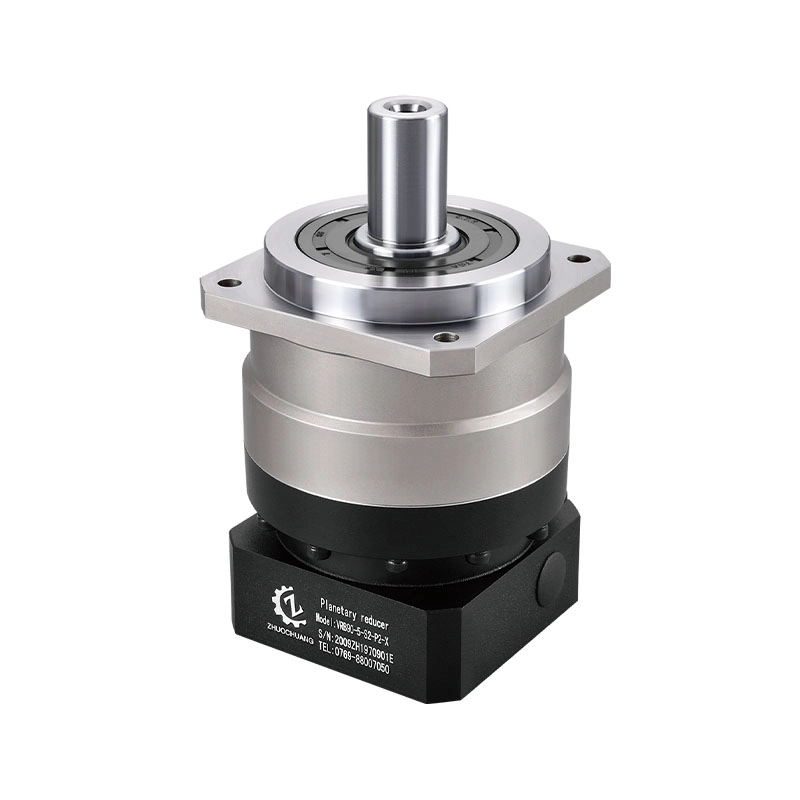
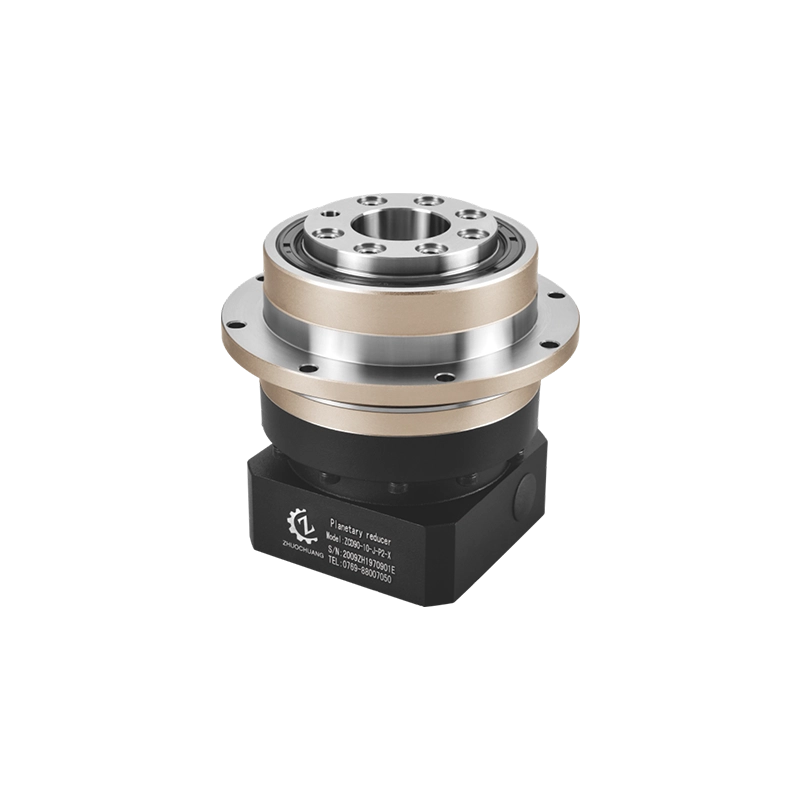
Dongguan Zhuochuang Precision Machinery Co., Ltd manufactures precision planetary gearboxes for servo automation, CNC machinery, robotics, packaging equipment and precision positioning systems.
For multistage planetary gearbox selection, our role is not simply to recommend more stages. The correct configuration depends on ratio, torque, backlash, efficiency, mounting space, motor interface and duty cycle.
You can view our main product range here:
Precision Planetary Gearbox Range
For inline servo applications, you can also view:
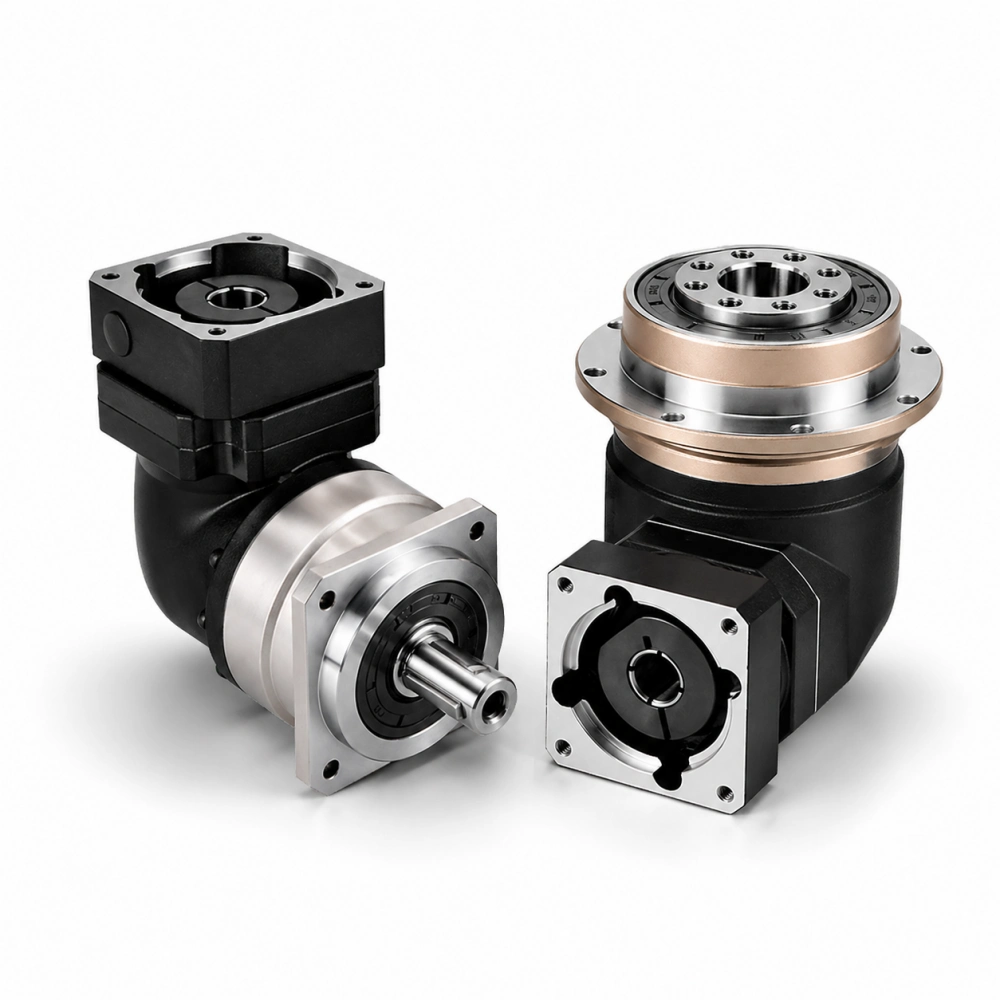
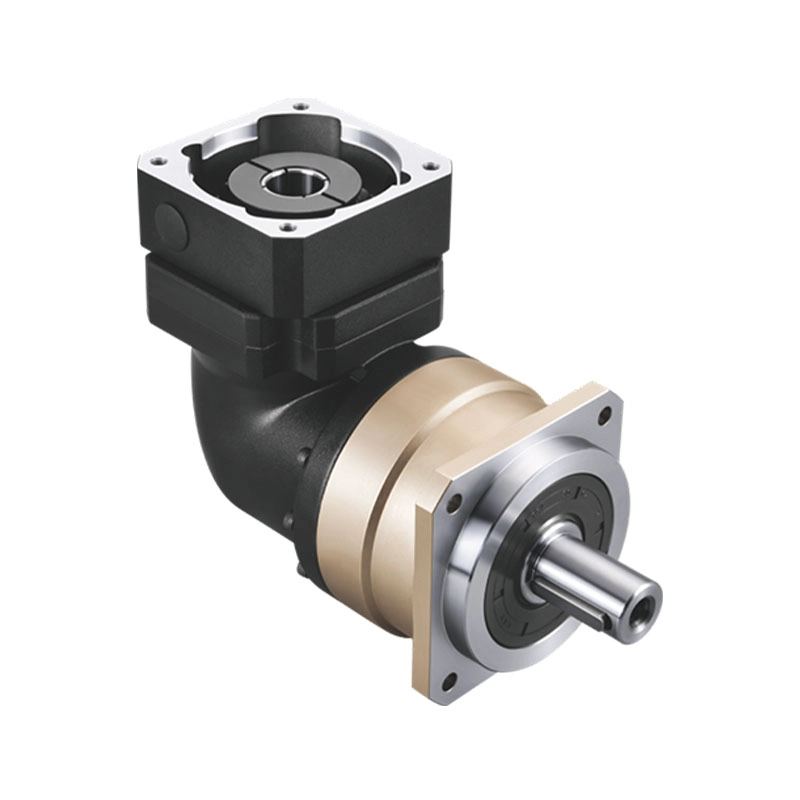
If your machine requires a 90-degree layout, see:
Need Help Checking Stage Count?
Send us your motor model, input speed, required output speed, output torque, backlash target, duty cycle and mounting drawing. Zhuochuang can help review whether your application needs a single-stage, two-stage or multistage planetary gearbox.
Final Selection Logic
Use a single-stage planetary gearbox when the ratio is within the practical single-stage range and the machine benefits from maximum efficiency, shorter length and simpler structure.
Use a 2-stage planetary gearbox when the required ratio is higher than a single stage can provide, but the machine still needs compact size, good stiffness, and manageable efficiency loss.
Use a 3-stage planetary gearbox when the ratio requirement is very high and the application can accept longer housing, lower efficiency, more heat, higher cost and more careful backlash confirmation.
The best multistage planetary gearbox is not the one with the most stages. It is the one whose stage count matches the machine’s required ratio, torque, accuracy, duty cycle and space limit.