
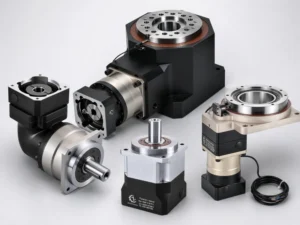
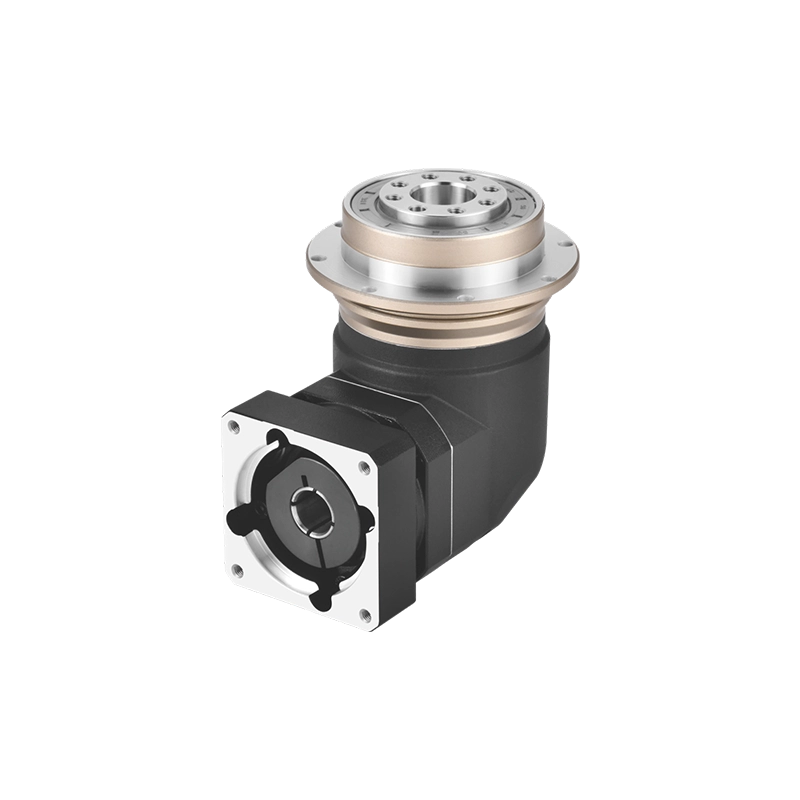
If you are comparing a planetary gearbox vs harmonic drive for a precision motion application, you are already beyond the basic reducer selection stage.
Both technologies can work with servo motors. Both can support low-backlash motion. Both appear in robotics, semiconductor equipment, laboratory automation, optical positioning systems, and precision machinery.
The real question is not which technology sounds more advanced.
The real question is which mechanical behavior fits your machine: near-zero unloaded backlash from a flexible strain-wave mechanism, or high torsional stiffness and efficiency from a rigid gear-mesh planetary design.
A harmonic drive can be excellent in small-frame, low-speed, moderate-load applications where zero unloaded backlash is critical. A precision planetary gearbox often becomes the more practical choice when the machine needs higher stiffness, better efficiency, stronger torque capacity, easier servo tuning, continuous-duty performance, and a lower total cost across multiple axes.
This article compares the two designs across the technical factors that matter in real precision motion systems: mechanism behavior, torsional stiffness, backlash, torque density, efficiency, cost, and application fit.
What Each Mechanism Is Actually Doing
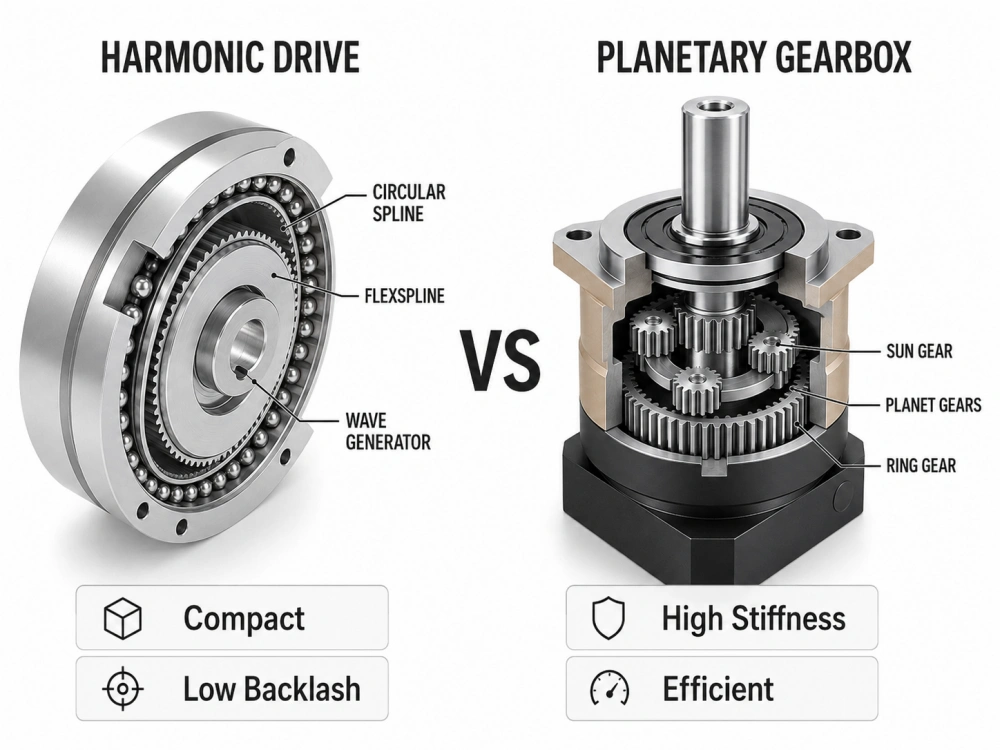
A harmonic drive, also called a strain wave gear, uses three main parts: a wave generator, a flex spline, and a circular spline.
The wave generator is usually an elliptical bearing. It deforms the flex spline into an elliptical shape so that the external teeth of the flex spline engage with the internal teeth of the circular spline at two opposite areas. As the wave generator rotates, the engagement points move around the circumference.
The flex spline and circular spline normally have a small tooth count difference. This tooth difference creates the reduction ratio.
The advantage is clear: the teeth stay engaged with almost no free play, so the harmonic drive can achieve near-zero unloaded backlash.
But the same flexible part that creates the zero-backlash advantage also creates compliance. The flex spline must deform to work. Under torque load, it can wind up slightly. That elastic behavior affects torsional stiffness, dynamic response, and load-dependent positioning accuracy.
A planetary gearbox works differently.
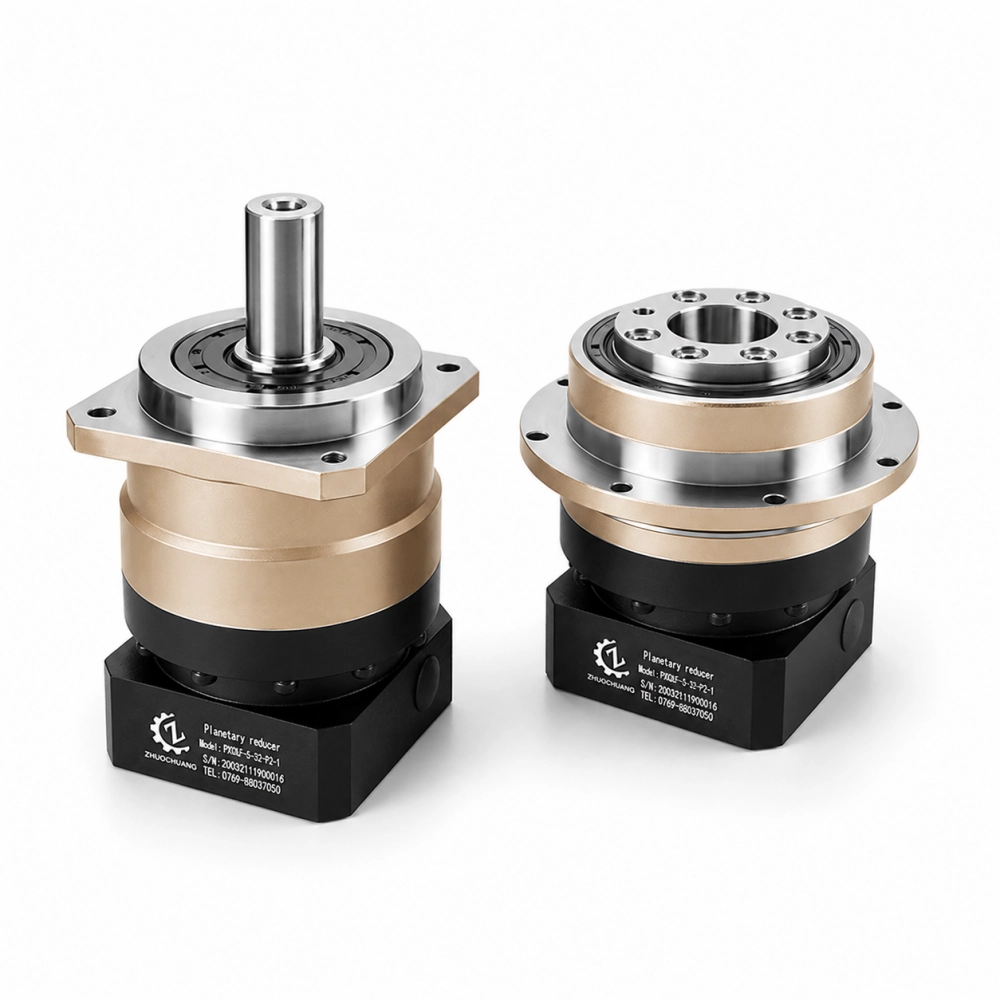
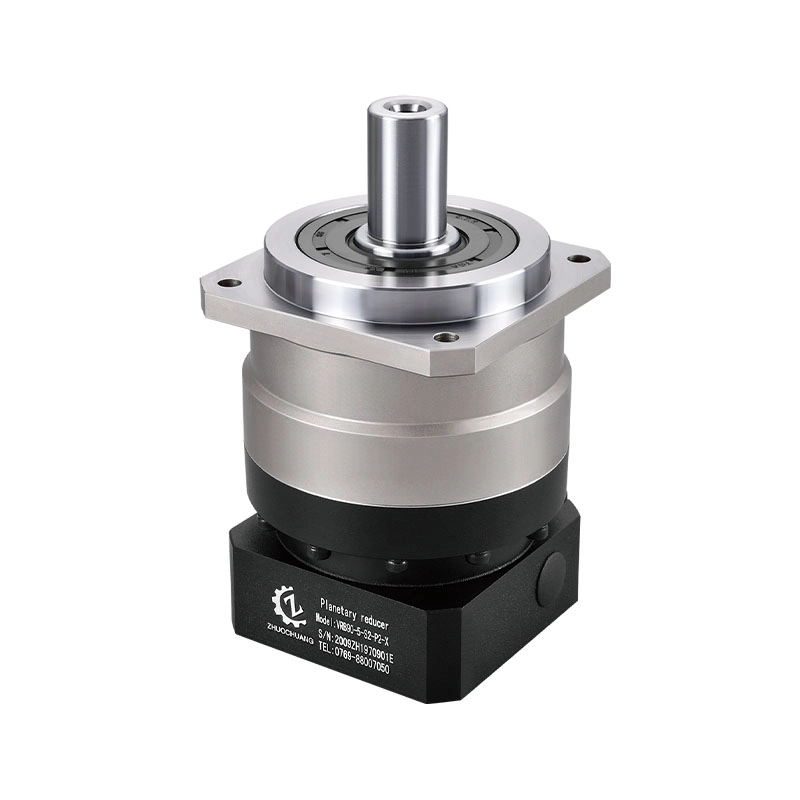
It uses a sun gear, planet gears, ring gear, and planet carrier. The motor drives the input, several planet gears share the load, and the planet carrier delivers the output. The gear meshes are rigid compared with the flex spline of a harmonic drive.
The advantage is also clear: a precision planetary gearbox provides high torsional stiffness, high efficiency, good torque density, and direct servo motor integration.
The trade-off is that a planetary gearbox normally has small but measurable backlash because rigid gear teeth require controlled clearance. In precision servo grades, this backlash can be very low, but it is usually not zero.
So the comparison is not simple.
A harmonic drive offers near-zero unloaded backlash, but it has elastic compliance.
A precision planetary gearbox has small measurable backlash, but it provides higher stiffness and more predictable behavior under changing load.
That difference is the foundation of the entire selection decision.
Torsional Stiffness: The Parameter Many Buyers Underestimate
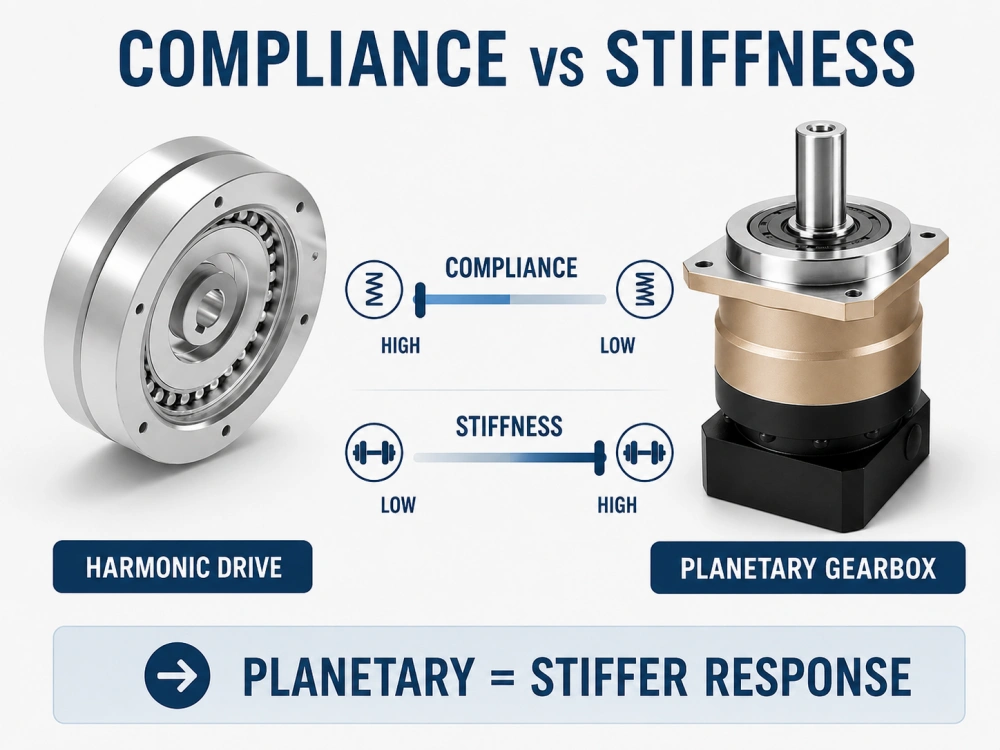
Torsional stiffness describes how much the reducer twists under torque.
For servo motion, this is one of the most important performance factors.
A harmonic drive’s flex spline deflects under torque load before transmitting that torque to the output. This torsional wind-up is load-dependent. The more torque applied, the more the output position can lag behind the ideal position.
In a slow positioning system, this may not be a serious problem. The servo controller can move carefully, settle, and reach the target position.
In a high-response servo system, compliance can become a real limitation. The servo loop may need lower gain to avoid vibration or oscillation. This can reduce response speed, path accuracy, and machine cycle performance.
A precision planetary gearbox is usually much stiffer. Rigid gear meshes, ground gear teeth, controlled bearing support, and a strong carrier structure help transmit torque with less elastic twist.
This stiffness is important in applications such as:
CNC interpolation
Laser cutting head positioning
High-speed pick-and-place systems
Packaging axes with frequent start-stop motion
Automated assembly equipment
Servo indexing systems
Robot axes with changing payloads
When a machine depends on fast response and repeatable position under changing load, torsional stiffness can matter more than the unloaded backlash number.
Backlash: Near-Zero Is Not the Same as Error-Free Under Load
Backlash is where harmonic drives get the most attention.
A quality harmonic drive can offer near-zero backlash under light or zero-load conditions. This advantage is real. The flex spline teeth remain engaged with the circular spline, so there is almost no free play when direction changes.
But backlash is not the only source of positioning error.
Under working load, the flex spline can deflect. This load-dependent compliance can shift the output position even when mechanical play is almost zero.
That means a harmonic drive may show excellent unloaded backlash but still produce positioning deviation when torque changes.
A precision planetary gearbox usually has small but measurable backlash. For precision servo grades, backlash values below 3 arcminutes are common, and high-precision grades may be lower.
The important difference is that a stiff planetary gearbox tends to hold its output position more predictably under changing load. Its backlash does not disappear, but the structure does not depend on a flexible cup deforming under torque.
So the better question is not only:
Which reducer has lower backlash?
The better question is:
Which reducer gives more predictable output position under the real working load?
For applications with constant and well-characterized load, a harmonic drive can perform extremely well.
For applications with variable load, changing cutting force, changing payload, high acceleration, or frequent direction reversal, a precision planetary gearbox may provide more stable positioning behavior.
Torque Capacity and Torque Density
Torque comparison between harmonic drives and planetary gearboxes depends strongly on frame size.
In very small sizes, harmonic drives can offer excellent torque density. Their compact structure and high ratio make them attractive in small robot joints, compact instruments, camera positioning systems, and lightweight precision devices.
As frame size increases, the limitation of the flex spline becomes more important. The flex spline is a flexible load-carrying component. It has fatigue and elastic load limits that must be respected.
A planetary gearbox uses rigid gears and can scale torque capacity by increasing gear size, gear width, planet count, bearing support, and housing structure.
This is why precision planetary gearboxes often become more attractive in medium and larger frame sizes.
A practical way to view the difference:
| Frame Size | Harmonic Drive | Precision Planetary Gearbox |
|---|---|---|
| Small frame | Very compact, strong zero-backlash advantage | Also viable, usually stiffer |
| Medium frame | Useful, but flex spline load limit becomes important | Strong torque and stiffness balance |
| Large frame | Torque and fatigue limits become more restrictive | Clearer advantage in torque capacity |
This does not mean harmonic drives are weak. It means their best range is more specific.
For small, moderate-load, zero-backlash applications, harmonic drives can be excellent.
For industrial servo automation where the reducer must handle larger torque, repeated acceleration, higher duty cycles, and variable load, a precision planetary gearbox often provides a better balance of torque capacity and long-term stiffness.
Efficiency and Heat
Efficiency is another area where the difference is practical.
A harmonic drive must continuously deform the flex spline during operation. This elastic cycling consumes energy. The wave generator bearing and tooth contact also contribute to energy loss.
A quality harmonic drive may provide acceptable efficiency for many low-power or intermittent-duty applications, but it is usually less efficient than a comparable precision planetary gearbox.
A precision planetary gearbox uses rolling gear contact through rigid gear meshes. In a high-quality unit, efficiency per stage is typically high, which means more input power becomes usable output torque.
For industrial machines, efficiency affects more than electricity cost.
It affects heat.
A less efficient reducer generates more heat inside the housing. In continuous-duty applications, heat can shorten lubricant life, affect seals and bearings, reduce service life, and create thermal stability problems.
This matters in:
Continuous-duty servo axes
Multi-axis automation lines
High-speed packaging machinery
CNC equipment
Robotic systems with repeated motion
Systems where motor size and thermal load are limited
If the axis runs only occasionally, the efficiency difference may not decide the selection.
If the axis runs continuously or at high cycle rate, the efficiency difference can become an important reason to choose a precision planetary gearbox.
Servo Bandwidth and Dynamic Response
A servo motor does not work alone. The reducer is part of the servo control chain.
If the reducer is compliant, the servo controller may see one motion at the motor side while the output side behaves slightly differently under load. This can limit how aggressively the servo can be tuned.
A harmonic drive’s compliance can require more conservative tuning in high-response systems. This does not make the harmonic drive unsuitable. It means the control system must account for the mechanical behavior.
A precision planetary gearbox provides a stiffer connection between motor and load. This can allow higher servo gains, quicker response, and more predictable behavior during acceleration, braking, and reversing.
This is why planetary gearboxes are often selected for servo-driven industrial equipment where cycle time and repeatability matter.
The key point is simple:
A harmonic drive may win on zero unloaded backlash.
A precision planetary gearbox often wins on dynamic stiffness and response.
Cost and Total Value
Price comparison should not stop at unit price.
Harmonic drives, especially high-quality units from established manufacturers, often carry a price premium. The flex spline requires precise forming, material control, heat treatment, and tooth geometry. The wave generator and circular spline must also be manufactured accurately.
Precision planetary gearboxes are produced in larger global volumes and use mature gear grinding, bearing support, and assembly processes. For many torque sizes and accuracy grades, they offer a lower cost per unit of output torque.
But the real cost is not only the reducer price.
The real cost includes:
Servo tuning time
Motor oversizing
Heat management
Machine redesign
Replacement cost
Lead time
Multi-axis system cost
Positioning error risk
Maintenance and downtime
For a small precision joint where zero unloaded backlash is mandatory, a harmonic drive may justify its higher cost.
For industrial servo automation, CNC machinery, packaging equipment, and multi-axis systems, a precision planetary gearbox often provides a more practical balance of torque, stiffness, efficiency, availability, and cost per axis.
The better value is not always the cheaper reducer.
It is the reducer that avoids tuning problems, heat buildup, oversizing, premature wear, and positioning error in the real machine.
Where Harmonic Drives Fit Best
Harmonic drives are not outdated or inferior. They solve a specific set of problems very well.
They are worth serious consideration when the application has:
Small frame size
Moderate torque
Constant or predictable load
Near-zero unloaded backlash requirement
Slow or moderate dynamic response
Weight-sensitive design
Compact precision positioning need
Limited space for reduction mechanism
Typical examples may include:
Small robot wrist joints
Optical positioning systems
Laboratory automation
Camera gimbals
Semiconductor positioning stages
Compact medical or inspection equipment
Small precision rotary axes
In these applications, the zero-backlash and compact structure of a harmonic drive can be more important than maximum stiffness or efficiency.
Where Precision Planetary Gearboxes Fit Best
Precision planetary gearboxes become stronger when the application requires stiffness, efficiency, torque capacity, and servo response.
They are often a better fit when the application has:
Medium or larger frame size
Higher torque requirement
Variable load
Frequent acceleration and deceleration
High servo bandwidth
Continuous duty cycle
High input speed
Need for low heat generation
Cost sensitivity across multiple axes
Need for standard motor adapter compatibility
Requirement for documented backlash and torque data
Typical examples include:
CNC machinery
Packaging equipment
Automated assembly systems
Servo indexing axes
High-speed pick-and-place systems
Industrial motion modules
Robotics auxiliary axes
Precision conveyor synchronization
Rotary positioning equipment
In these applications, the precision planetary gearbox is often the more practical industrial choice.
It may not offer zero unloaded backlash, but it provides high stiffness, high efficiency, stable torque transmission, and easier servo integration.
Selection Map: Planetary Gearbox vs Harmonic Drive
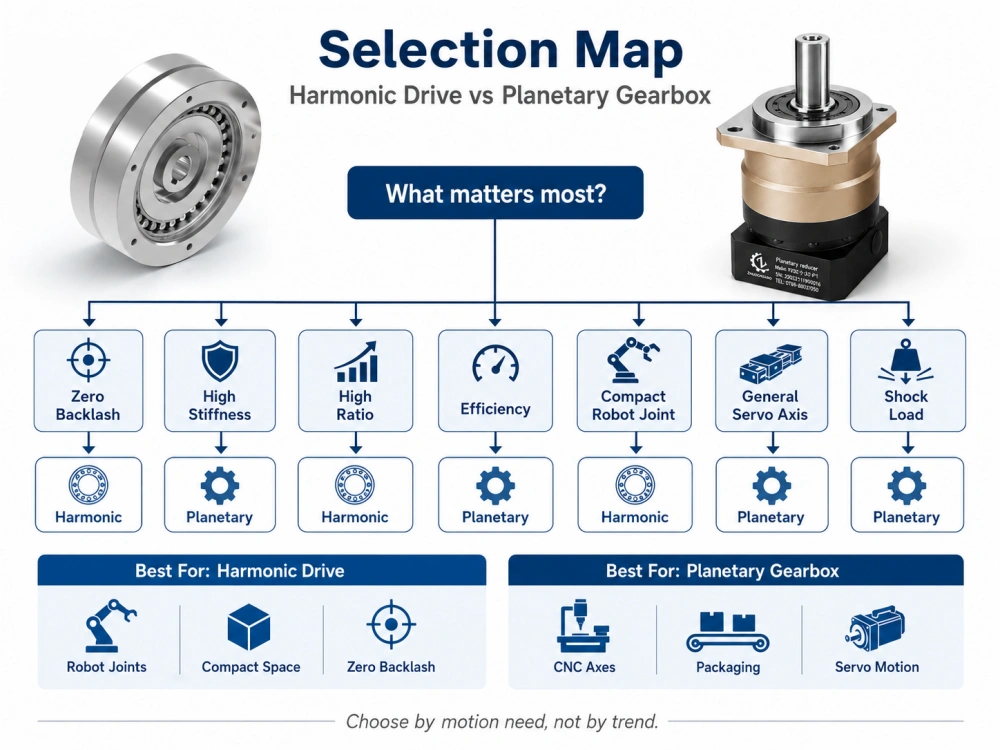
The decision can be simplified into a few practical questions.
If the application is small, light, slow, and requires near-zero unloaded backlash, evaluate a harmonic drive first.
If the application is medium or large, torque-demanding, variable-load, continuous-duty, or high-speed servo controlled, evaluate a precision planetary gearbox first.
If the machine needs fast response and stable output under changing load, torsional stiffness should be weighted heavily.
If the machine needs zero unloaded backlash and the load is stable, the harmonic drive advantage becomes more important.
If the machine uses many servo axes, compare total cost per axis, not only the price of one reducer.
If the machine runs continuously, compare efficiency and heat generation.
If the system must be easy to source, mount, and replace, compare availability and motor adapter compatibility.
[Image 2 Placeholder]
File name: planetary-gearbox-vs-harmonic-drive-selection-map.webp
ALT: planetary gearbox vs harmonic drive selection map for servo automation
Suggested caption: Selection depends on frame size, load variation, stiffness, efficiency, backlash requirement, and servo response.
A Practical Selection Shortcut
Choose a harmonic drive when the application is small, the load is moderate and predictable, zero unloaded backlash is critical, and the servo motion can tolerate lower torsional stiffness.
Choose a precision planetary gearbox when the application needs higher stiffness, better efficiency, stronger torque capacity at medium or larger frame sizes, faster servo response, continuous-duty operation, or lower total cost across multiple axes.
For many industrial automation systems, this is why planetary gearboxes remain the practical choice even when harmonic drives appear attractive on backlash alone.
What to Confirm Before Choosing
Before choosing between a planetary gearbox and harmonic drive, confirm the real application data.
Important points include:
Motor type and speed
Required output speed
Required ratio
Continuous torque
Peak torque
Load variation
Backlash requirement
Required stiffness
Duty cycle
Allowed temperature rise
Available installation space
Frame size limits
Servo response requirement
Direction reversal frequency
Weight limit
Cost target
Required service life
Mounting interface
Output structure
Lead time and supplier support
A correct selection cannot be made from product name alone.
It must be made from the machine requirement.
Where Zhuochuang Fits
Dongguan Zhuochuang Precision Machinery Co., Ltd focuses on precision planetary gearboxes for servo automation applications where torque capacity, torsional stiffness, efficiency, motor adapter compatibility, and documented backlash specifications are deciding parameters.
This article is not saying harmonic drives are unsuitable.
Harmonic drives are valuable in small-frame, zero-backlash, moderate-load applications where the load is predictable and the servo response requirement is not the limiting factor.
Zhuochuang fits the other side of the comparison: industrial machines where stiffness, efficiency, repeatable positioning under changing load, and practical cost are more important than zero unloaded backlash alone.
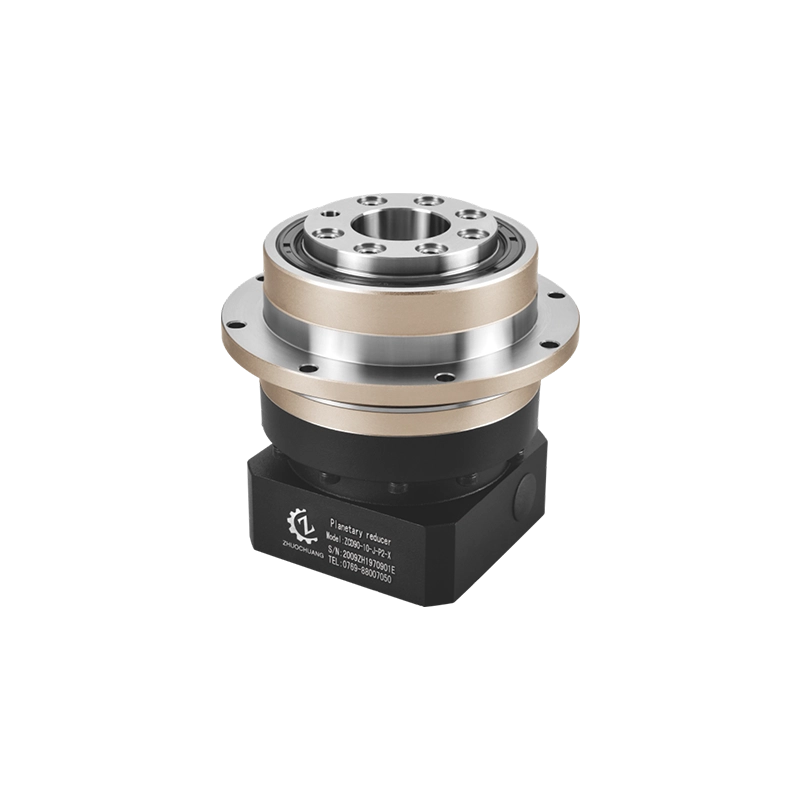
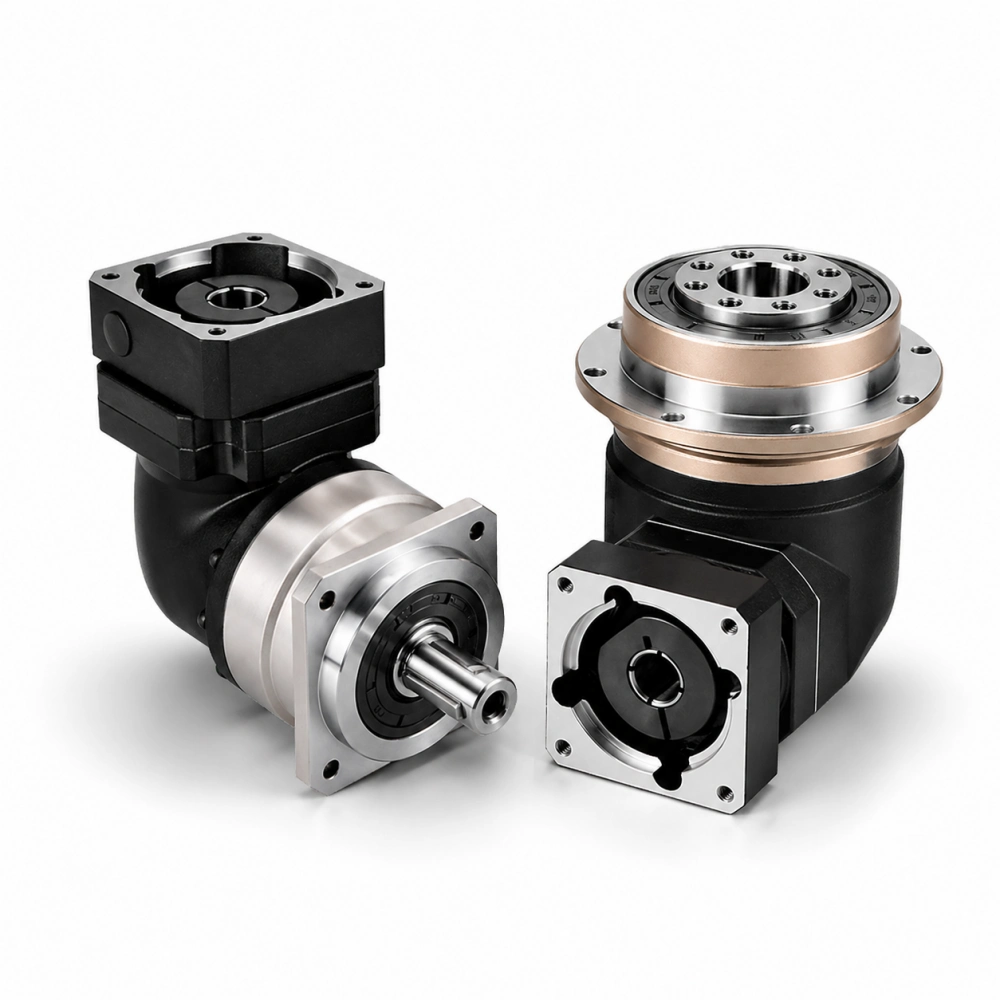
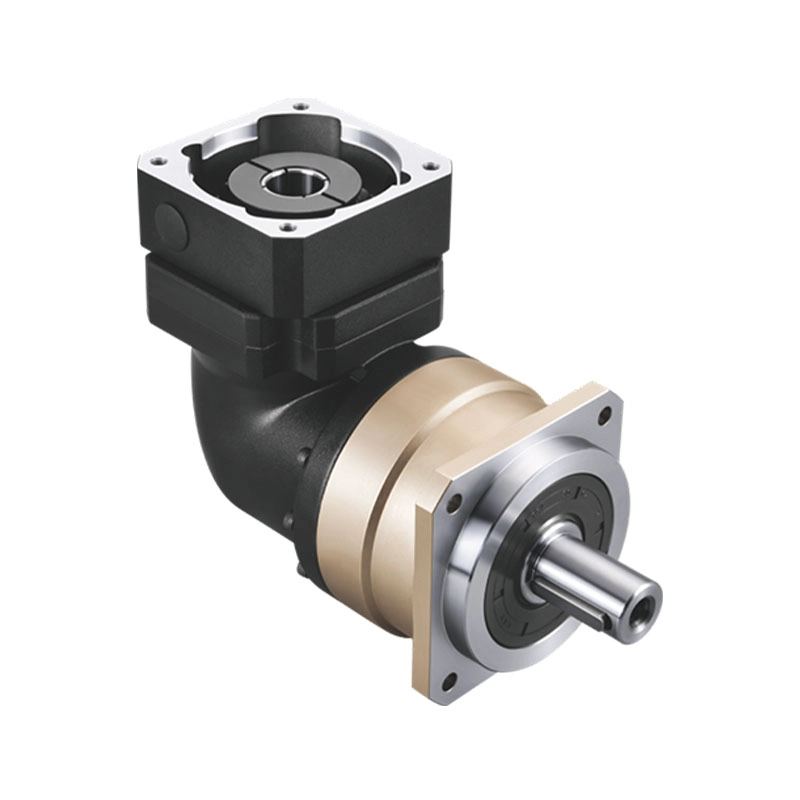
Our precision planetary gearboxes are available in inline and right-angle configurations for automation, CNC machinery, robotics, packaging equipment, and industrial motion systems.
If you are comparing planetary gearbox vs harmonic drive for a real machine, send us your motor model, required ratio, torque, duty cycle, backlash target, and mounting layout. Our technical team can help confirm whether a precision planetary gearbox is the right fit.
Browse our precision planetary gearbox range →
Contact us for technical support and quotation →
Dongguan Zhuochuang Precision Machinery Co., Ltd
planetdrivepro.com
Related Reading
Cycloidal vs Planetary Gearbox: Accuracy, Torque and Application Differences
Worm Gear Reducer vs Planetary Gearbox: Which Fits Automation?
Low Backlash Planetary Gearbox: Why Backlash Matters in Servo Systems
Planetary Gearbox Efficiency: Typical Values, Losses and Design Factors