
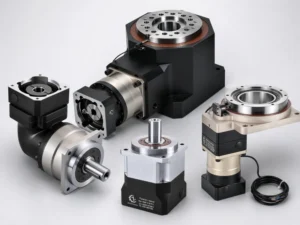
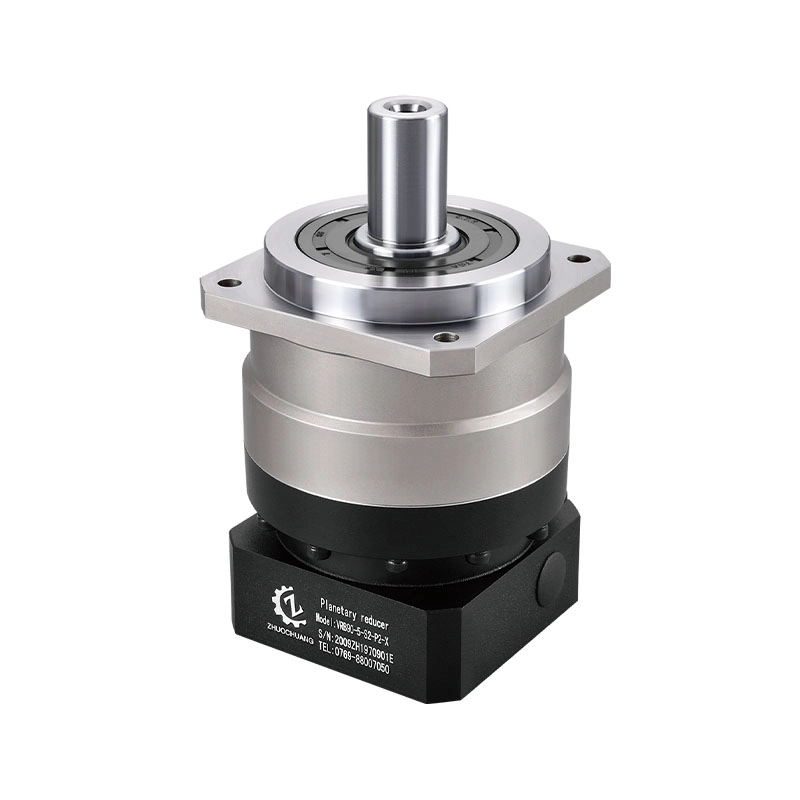
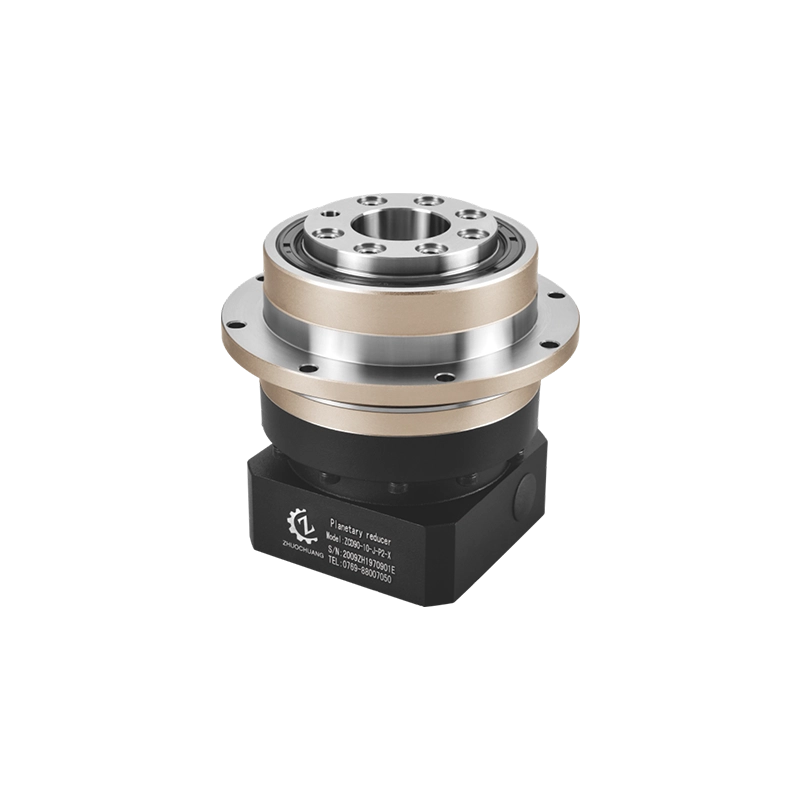
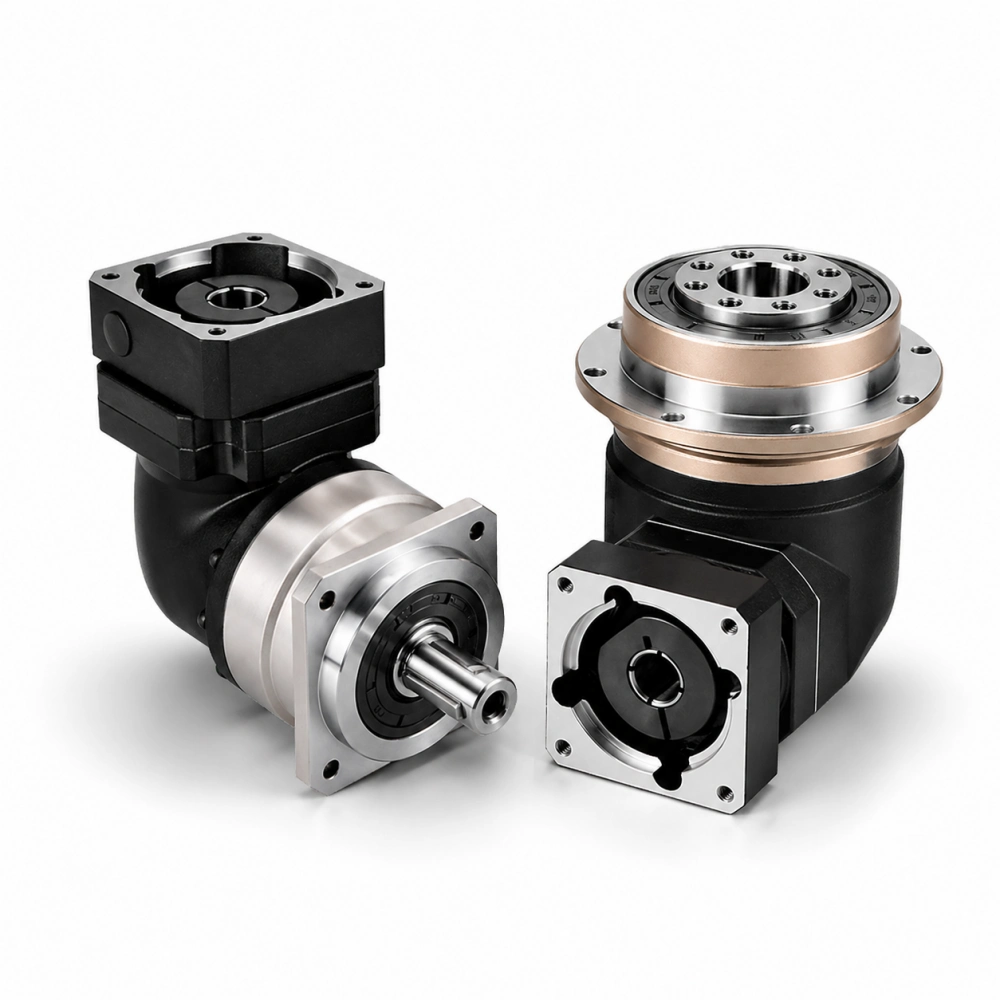
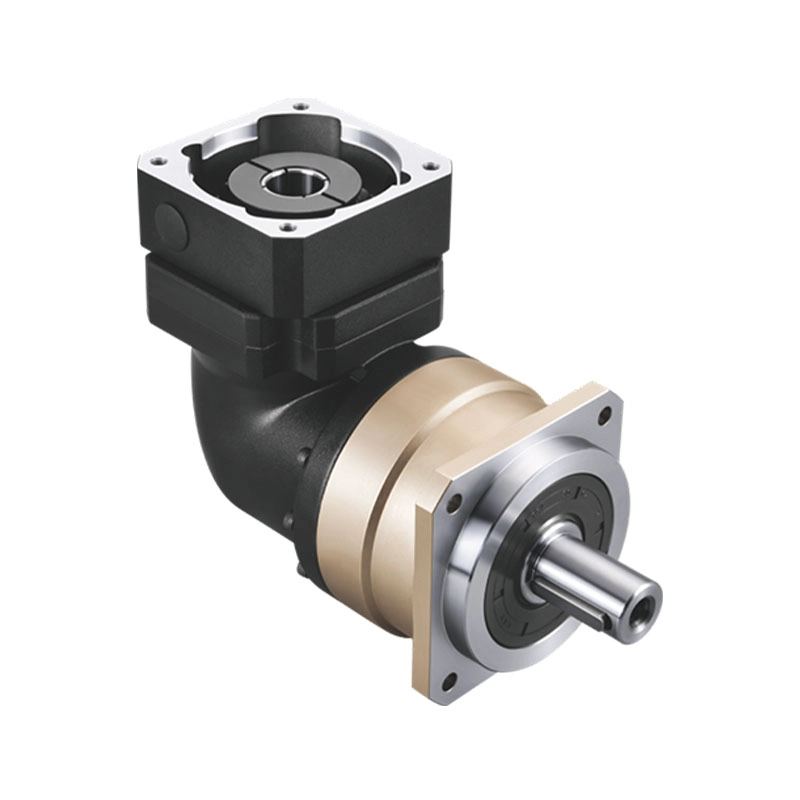
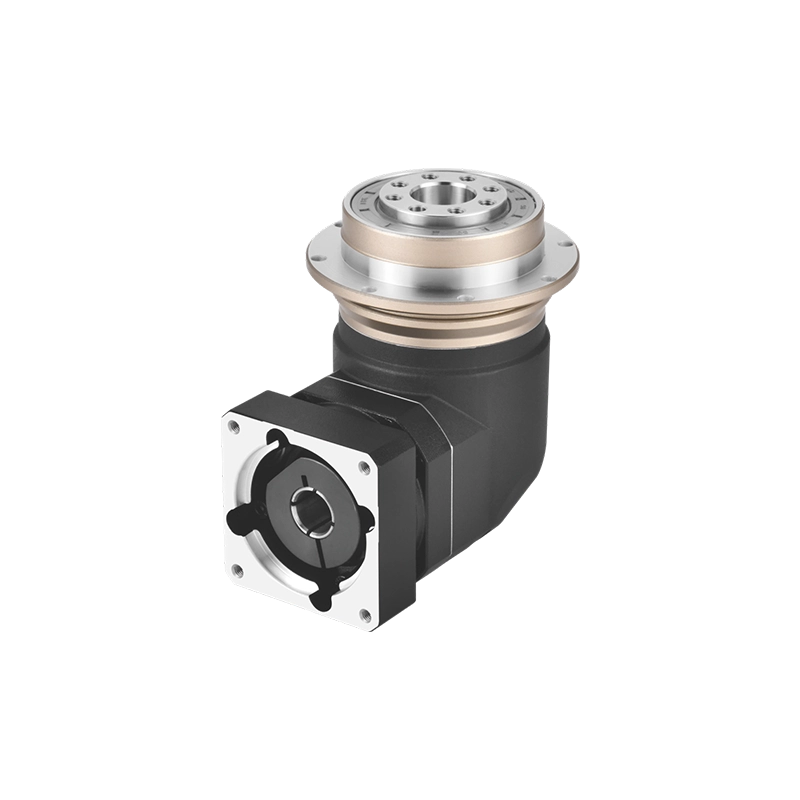
A rotary actuator converts power into controlled rotary motion. In automation equipment, this motion may be used to turn a fixture, index a workpiece, rotate a tooling station, position a camera angle, or drive a compact machine module.
For machine builders, the important question is not only “what is a rotary actuator?” The more practical question is: which type of rotary actuator is suitable for the load, accuracy, cycle time, installation space, and control method of the machine?
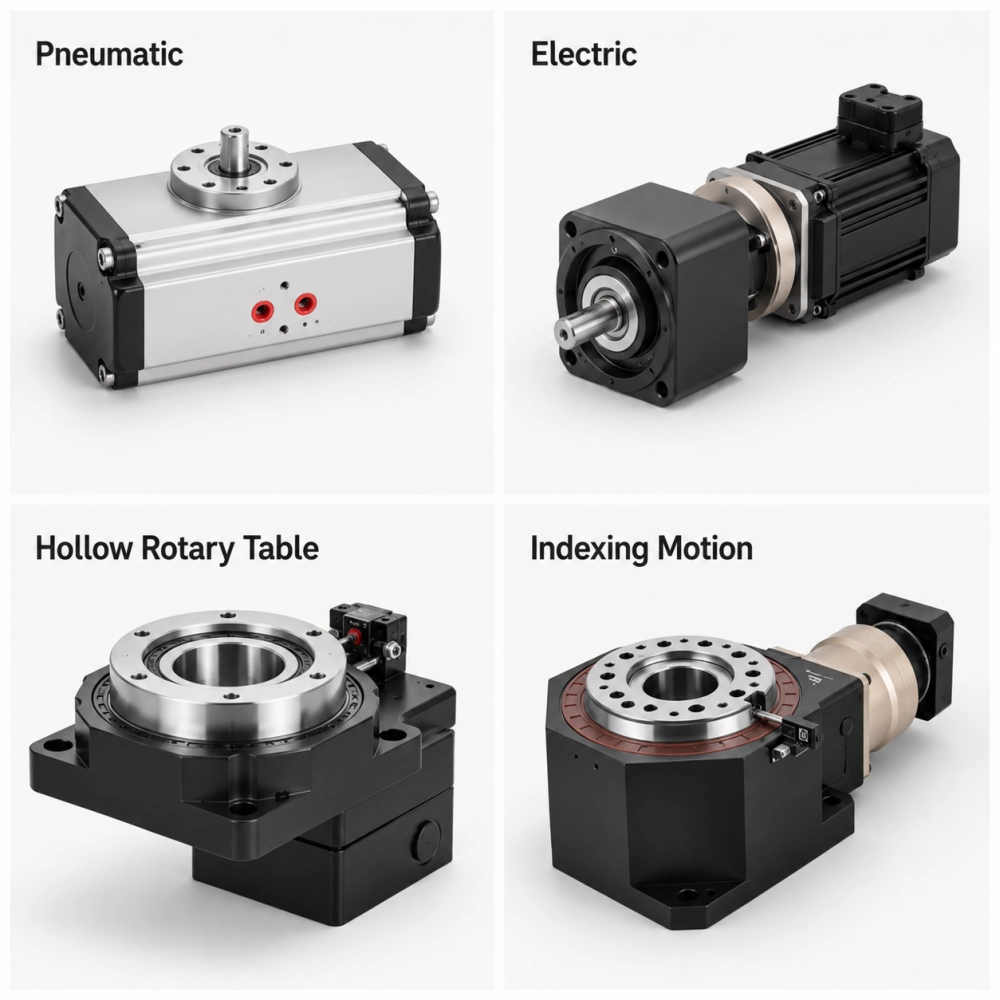
Some rotary actuators are simple pneumatic devices used for limited-angle motion. Some are electric units used for programmable positioning. Some are designed as precision rotary positioning tables with a hollow center for cable routing, air tubes, or fixture wiring. These differences directly affect machine layout, positioning accuracy, maintenance, and long-term stability.
This guide explains the main types of rotary actuators, how they work, and what to check before selecting one for industrial automation equipment.
What Is a Rotary Actuator?
A rotary actuator is a motion component that produces rotation instead of linear movement. It receives energy from air pressure, hydraulic pressure, an electric motor, or a servo drive system, then turns an output shaft, table, flange, or fixture.
In simple applications, a rotary actuator may only need to rotate between two fixed positions, such as 0° and 90°. In more advanced automation systems, it may need to stop at multiple angles, repeat positions accurately, support a fixture load, and work with sensors or servo control.
Rotary actuators are commonly used in:
- automated assembly machines
- indexing tables
- packaging equipment
- inspection systems
- robotic workstations
- electronic manufacturing equipment
- testing machines
- CNC-related positioning systems
In many modern machines, the rotary actuator is not just a small motion part. It becomes part of the equipment structure because it supports the fixture, carries the load, and affects the accuracy of the whole process.
Main Rotary Actuator Types
Rotary actuators can be grouped in several ways. The most useful way for machine selection is to classify them by power source and motion control method.
Pneumatic Rotary Actuators
A pneumatic rotary actuator uses compressed air to generate rotation. It is often used for simple open-close or swing actions.
Typical features include:
- fast response
- simple structure
- relatively low cost
- suitable for limited-angle movement
- easy integration into pneumatic systems
However, pneumatic rotary actuators are not ideal when the machine needs flexible angle control, accurate positioning, or stable speed control. Air pressure changes, impact at end positions, and mechanical stop wear can affect repeatability.
Pneumatic rotary actuators are suitable for simple actions such as turning a clamp, opening a gate, rotating a small arm, or switching between two fixed positions. They are less suitable for precision indexing or multi-position servo-controlled automation.
Hydraulic Rotary Actuators
A hydraulic rotary actuator uses hydraulic pressure to generate high torque. It is often used in heavy-duty equipment where force is more important than clean installation or high positioning flexibility.
Typical advantages include:
- high torque output
- strong load capacity
- good for heavy machinery
- compact power density
The main limitations are the hydraulic system itself. Oil leakage, maintenance, temperature, and system complexity make hydraulic rotary actuators less common in clean automation equipment or electronic assembly machines.
For factory automation, hydraulic rotary actuators are usually selected only when the load is heavy and the environment already uses hydraulic power.
Electric Rotary Actuators
An electric rotary actuator uses a motor and transmission structure to produce controlled rotation. Depending on the design, it may use a stepper motor, servo motor, gearbox, brake, encoder, or integrated control system.
Electric rotary actuators are widely used in automation because they offer better control than pneumatic systems. They can support programmable angles, adjustable speed, controlled acceleration, and integration with PLC or motion controllers.
Common advantages include:
- programmable rotary motion
- adjustable speed and acceleration
- better positioning control
- cleaner operation than hydraulic systems
- easier integration with modern automation controls
Electric rotary actuators are often used in inspection machines, indexing systems, packaging equipment, electronic assembly, and robotic auxiliary axes.
When the application needs repeatable angular positioning, electric actuation is usually more suitable than a simple pneumatic rotary actuator.
Servo Rotary Actuators
A servo rotary actuator uses a servo motor and feedback system to control position, speed, and torque more accurately. In many industrial machines, this is the preferred solution when flexible motion and repeatability matter.
A servo rotary actuator may be designed as:
- a servo motor with a gearbox
- a servo-driven rotary table
- a hollow rotary actuator
- a direct-drive rotary stage
- a custom rotary positioning module
Compared with simple motorized rotation, servo control allows the machine to stop at different angles, adjust motion profiles, synchronize with other axes, and improve process stability.
Servo rotary actuators are commonly used when the machine needs:
- multi-station indexing
- precise angular positioning
- variable rotation angles
- stable stopping accuracy
- programmable motion sequences
- integration with PLC or motion control systems
For this reason, servo-based rotary actuators are important in modern automation equipment.
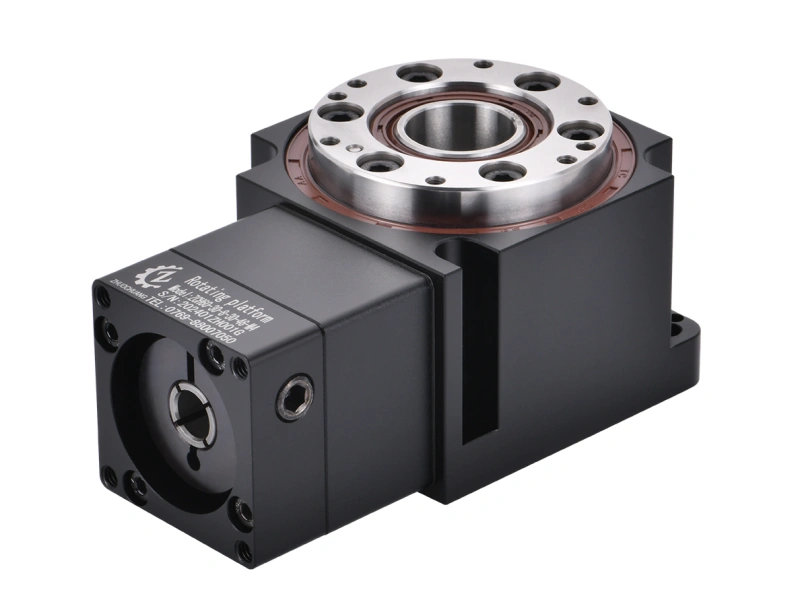
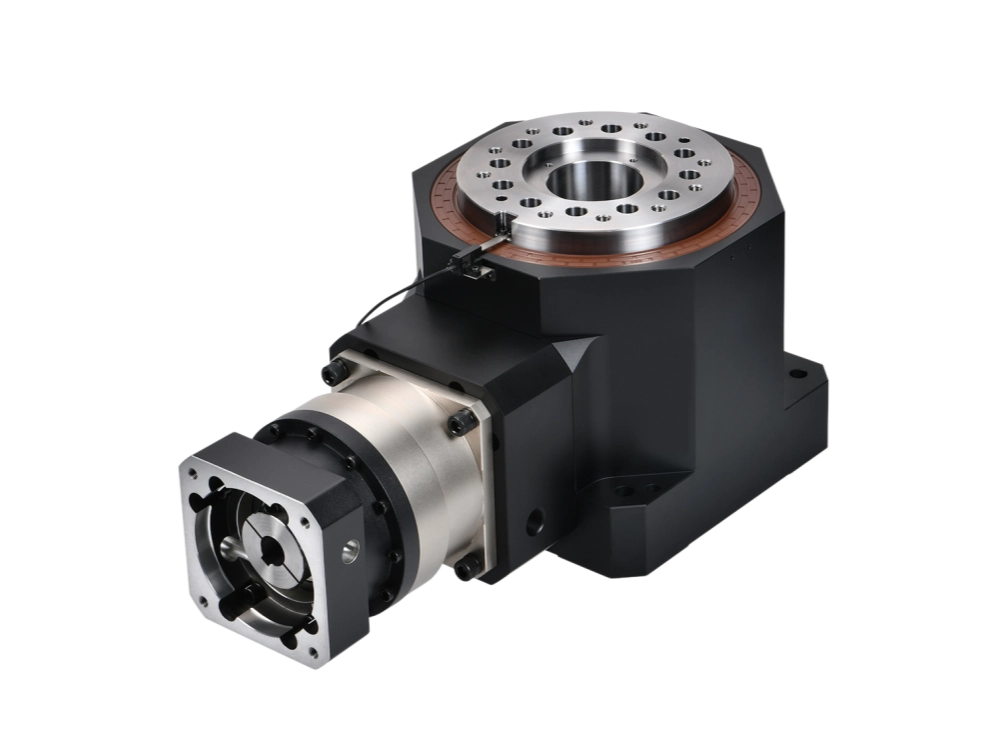
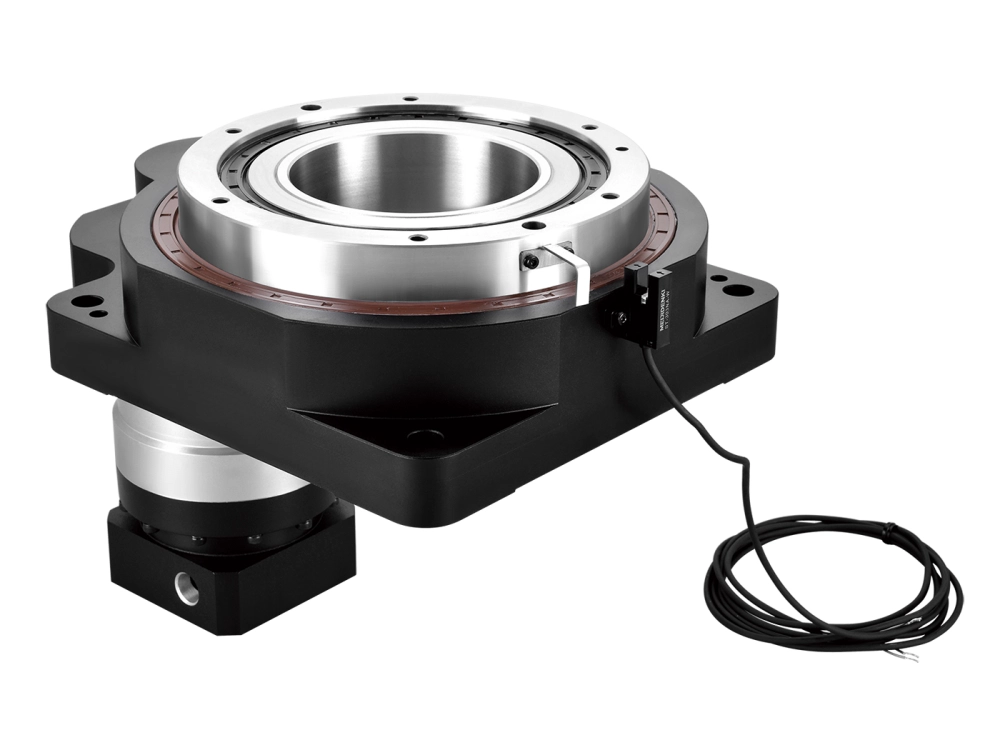
Hollow Rotary Actuators
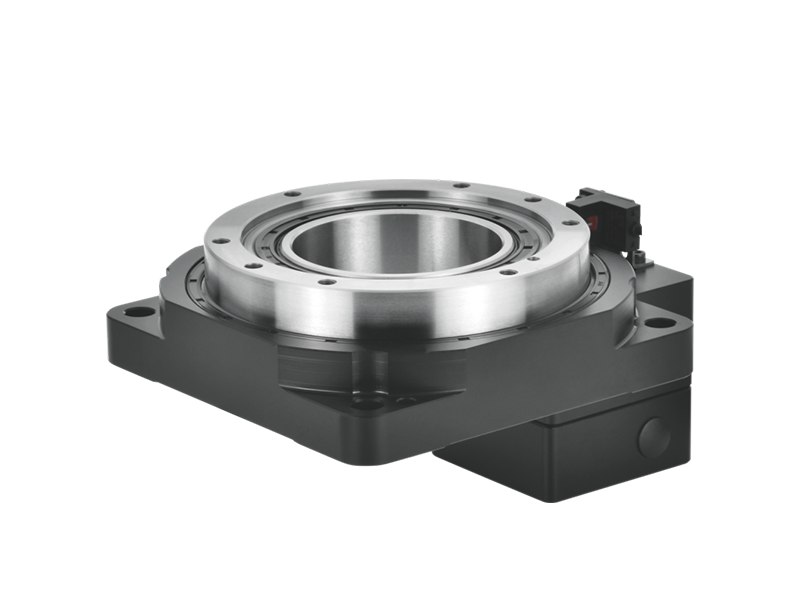
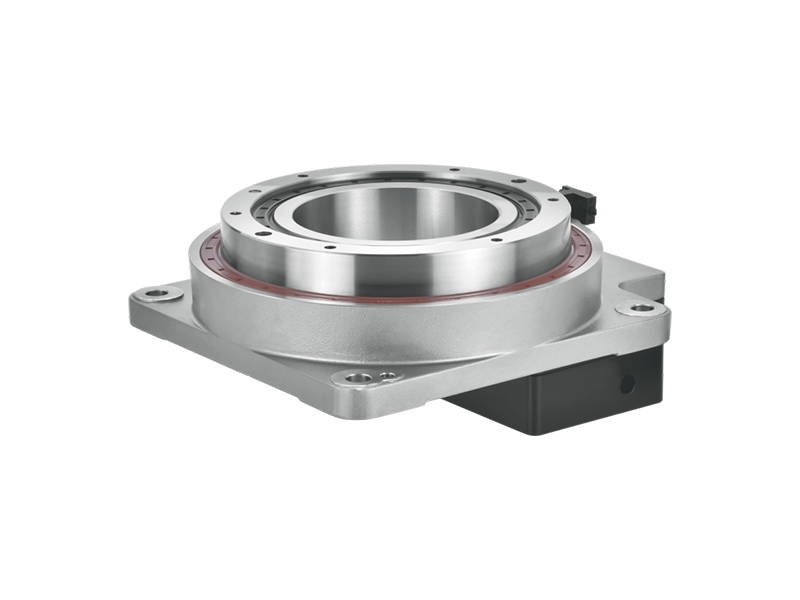
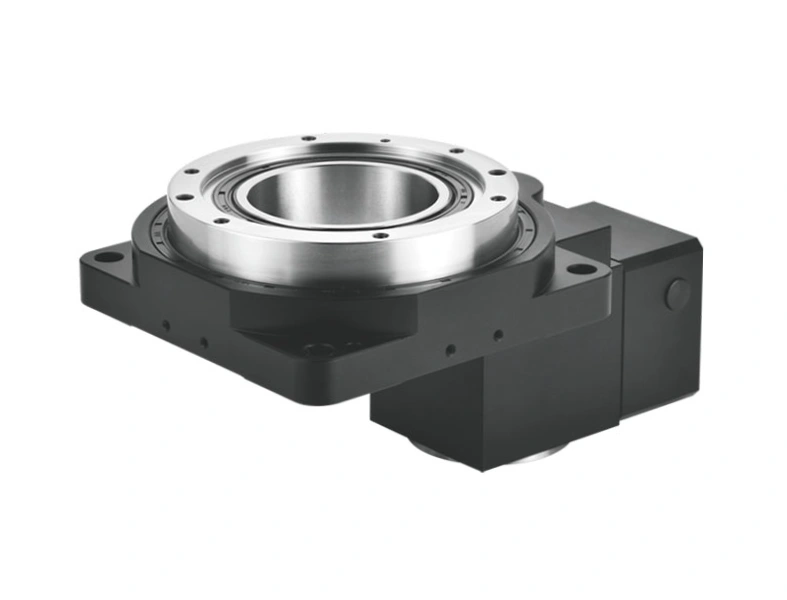
A hollow rotary actuator is a rotary positioning unit with a central through-hole. This hollow center allows cables, air tubes, vacuum lines, or fixture wiring to pass through the middle of the table.
This design is especially useful when the machine has a rotating fixture but still needs to route wires or tubes cleanly.
Typical advantages include:
- compact machine layout
- easier cable and air tube routing
- reduced external cable twisting
- better fixture integration
- suitable for automation and inspection equipment
- stable support for rotating loads
In many applications, a hollow rotary actuator works like a compact servo rotary table. It can support a fixture on the top surface while allowing services to pass through the center. This makes it practical for automated assembly, testing, vision inspection, packaging, and electronic manufacturing equipment.
For machine builders who need compact rotary positioning with a center hole, a hollow rotary actuator is often more practical than a simple motor-plus-coupling structure.
You can review Zhuochuang’s hollow rotary table product range for different hollow rotary table structures used in automation equipment.
Rotary Indexers
A rotary indexer is designed to move a table or fixture from one station to another. Instead of continuous rotation, it usually performs repeated indexed motion, such as 90°, 120°, 180°, or custom station angles.
Rotary indexers are widely used in multi-station assembly machines. One station may load parts, another may press, another may inspect, and another may unload.
Common rotary indexer types include:
- cam indexers
- servo indexers
- dial indexers
- gear-driven indexers
- rotary indexing tables
Cam indexers are known for mechanical stability and repeatable fixed indexing. Servo indexers provide more flexible angle control and programmable movement.
When choosing a rotary indexer, the key factors are station number, cycle time, load, indexing accuracy, drive type, and maintenance requirements.
Direct Drive Rotary Actuators
A direct drive rotary actuator connects the motor directly to the rotary output without a traditional gearbox. It is often used when high dynamic response, smooth motion, and high precision are required.
Direct drive systems can provide excellent accuracy, but they may require more careful control, higher cost, and appropriate protection for load and impact conditions.
For some high-end applications, direct drive rotary tables are suitable. For many industrial automation machines, however, a gear-driven hollow rotary table or servo rotary table may offer a more practical balance between cost, torque, rigidity, and installation convenience.
This is why machine builders should compare direct drive, geared rotary actuators, and hollow rotary tables based on real operating conditions rather than only catalog accuracy.
How a Rotary Actuator Works
The working principle depends on the actuator type, but the basic process is similar:
- The actuator receives power from air, oil, or electricity.
- The internal mechanism converts that power into rotation.
- The output shaft, flange, or table rotates the connected fixture or machine part.
- The actuator stops at the required position, either by mechanical stops, sensors, encoder feedback, or servo control.
For a simple pneumatic actuator, the stop position may be defined by mechanical end stops.
For a servo rotary actuator, the stop position is controlled by the motor, encoder, and motion controller.
For a hollow rotary table, the actuator may combine a motor, reduction mechanism, bearing support, and hollow output structure.
The more demanding the application is, the more important the drive structure becomes. A low-cost actuator may rotate, but it may not provide enough repeatability, rigidity, or load support for precision automation.
Key Selection Factors for Rotary Actuators
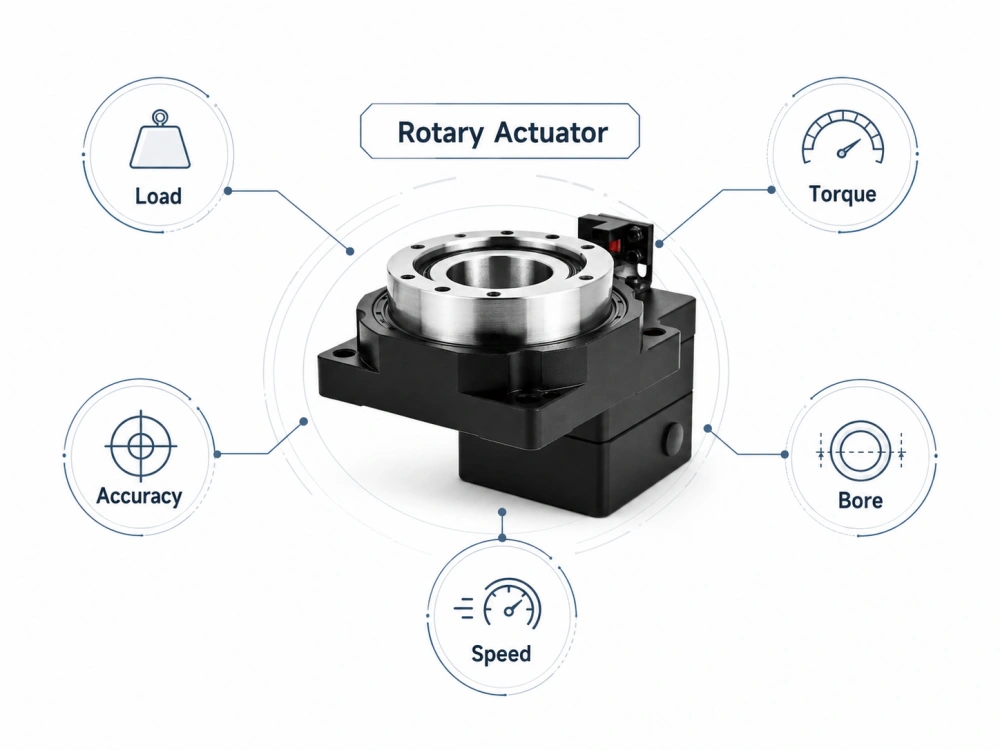
Choosing a rotary actuator is not only about matching torque. A suitable selection should consider the whole machine condition.
Rotation Angle and Motion Pattern
First, confirm whether the actuator needs limited-angle rotation or full rotary positioning.
Some machines only need 90° or 180° motion. Others need programmable positions, such as 30°, 45°, 60°, 120°, or continuous indexing.
You should confirm:
- required rotation angle
- number of stop positions
- whether angles are fixed or programmable
- whether motion is continuous or intermittent
- whether the actuator must reverse frequently
A simple pneumatic actuator may be enough for fixed two-position movement. A servo rotary actuator or hollow rotary table is better for flexible positioning.
Load and Moment
The actuator must support the workpiece, fixture, and any external force during operation. Many selection mistakes happen because users only check torque and ignore moment load.
Important load factors include:
- workpiece weight
- fixture weight
- distance from load center to table center
- vertical or horizontal installation
- impact during stopping
- external pressing or inspection force
For a rotary positioning table, bearing rigidity and moment capacity can be as important as motor torque. If the table supports an offset fixture, the moment load must be checked carefully.
Torque Requirement
Torque is required to accelerate, rotate, and stop the load. The required torque depends on load inertia, rotation speed, acceleration time, friction, and duty cycle.
A rotary actuator should not be selected only by rated torque under ideal conditions. For indexing applications, acceleration and deceleration may create peak torque much higher than steady running torque.
Check:
- required output torque
- peak torque during acceleration
- holding torque
- safety factor
- duty cycle
- braking requirement
For servo-driven systems, motor and gearbox matching should also be checked together.
Positioning Accuracy and Repeatability
Accuracy and repeatability are often confused.
Accuracy describes how close the actual stop position is to the commanded position.
Repeatability describes how consistently the actuator returns to the same position.
For automation equipment, repeatability is often more important than absolute accuracy, especially when the machine can be calibrated.
Check:
- repeat positioning accuracy
- backlash
- lost motion
- output bearing runout
- rigidity under load
- long-term wear
For inspection equipment, assembly machines, and precision positioning systems, low backlash and stable repeatability are important selection points.
Hollow Bore and Cable Routing
If the rotating fixture needs wires, air tubes, vacuum lines, or sensor cables, the hollow bore becomes very important.
Without a hollow center, cables may need to be routed externally around the actuator. This can make the machine messy, increase cable bending, and create maintenance problems.
A hollow rotary actuator allows cleaner routing through the center. This is one reason hollow rotary tables are widely used in compact automation systems.
For example, the ZBT Series hollow rotary table is suitable for applications where a large center bore, rigid load support, and compact rotary positioning are required.
Speed and Cycle Time
Cycle time affects actuator selection. A slow manual-style rotary table may not be suitable for high-speed automation. A pneumatic actuator may move fast but may not stop smoothly enough for precision positioning.
Check:
- rotation angle per cycle
- required indexing time
- dwell time
- acceleration and deceleration
- duty cycle
- heat generation
- vibration at stopping
In high-cycle machines, stability over repeated operation matters more than one-time speed.
Installation Space
Many automation machines have limited space. A long inline motor arrangement may interfere with other parts of the machine.
In this situation, compact rotary actuators, right-angle motor layouts, hollow rotary tables, or integrated servo rotary units may help reduce machine size.
Before selection, confirm:
- available height
- available width
- motor direction
- cable exit direction
- fixture mounting method
- maintenance access
A compact actuator may save space, but it still needs enough rigidity and serviceability.
Control Method
The control method should match the machine system.
For simple machines, sensor-based control may be enough. For flexible automation, servo control is usually better.
Common control methods include:
- mechanical stops
- pneumatic valve control
- motor driver control
- stepper control
- servo control
- PLC motion commands
- encoder feedback
When the machine needs recipe changes, different product angles, or synchronized multi-axis movement, servo control is usually preferred.
Common Applications of Rotary Actuators
Rotary actuators are used in many industrial machines. The best actuator type depends on how the motion is used.
Automated Assembly Equipment
In assembly machines, rotary actuators often move fixtures between stations. The actuator may rotate parts for pressing, screwdriving, inspection, labeling, or unloading.
For these machines, repeatability, rigidity, and stable stopping are important. A hollow rotary table can also help route fixture cables or air lines through the center.
Vision Inspection Equipment
Vision inspection systems often need to inspect a part from several angles. A rotary positioning table can rotate the part under a camera, light source, or sensor.
In this application, smooth stopping and repeatable positioning are more important than high speed alone. If cables or pneumatic fixtures are mounted on the rotating side, a hollow bore design can make the layout cleaner.
Packaging Machinery
Packaging equipment may use rotary actuators for orientation, indexing, sealing, labeling, or product transfer.
The actuator must handle repeated cycles and maintain stable positioning over long production runs. Selection should consider speed, load, duty cycle, and maintenance access.
Robotic Workstations
A rotary actuator can work as an auxiliary positioning axis for a robot. It can rotate parts to a better pickup angle, inspection angle, or processing position.
This can reduce robot movement complexity and improve station efficiency.
Testing and Electronic Manufacturing Equipment
In testing equipment, rotary actuators may position fixtures, rotate test samples, or align products to sensors. In electronic manufacturing, they may help with soldering, inspection, assembly, or orientation.
For these applications, compact size, cable routing, and repeatability are often important.
Rotary Actuator Selection Checklist
Before choosing a rotary actuator, confirm the following points:
- What is the required rotation angle?
- Is the motion fixed or programmable?
- What is the workpiece and fixture weight?
- What is the load center distance?
- What torque is required during acceleration?
- What positioning accuracy is needed?
- What repeatability is required?
- Is backlash acceptable?
- Does the fixture need cables, air tubes, or vacuum lines?
- Is a hollow bore required?
- What is the cycle time?
- What is the duty cycle?
- What motor or control system will be used?
- What installation space is available?
- Is the actuator used horizontally or vertically?
- Is a standard product enough, or is customization required?
This checklist helps avoid selecting a rotary actuator based only on price or table diameter.
When to Choose a Hollow Rotary Table
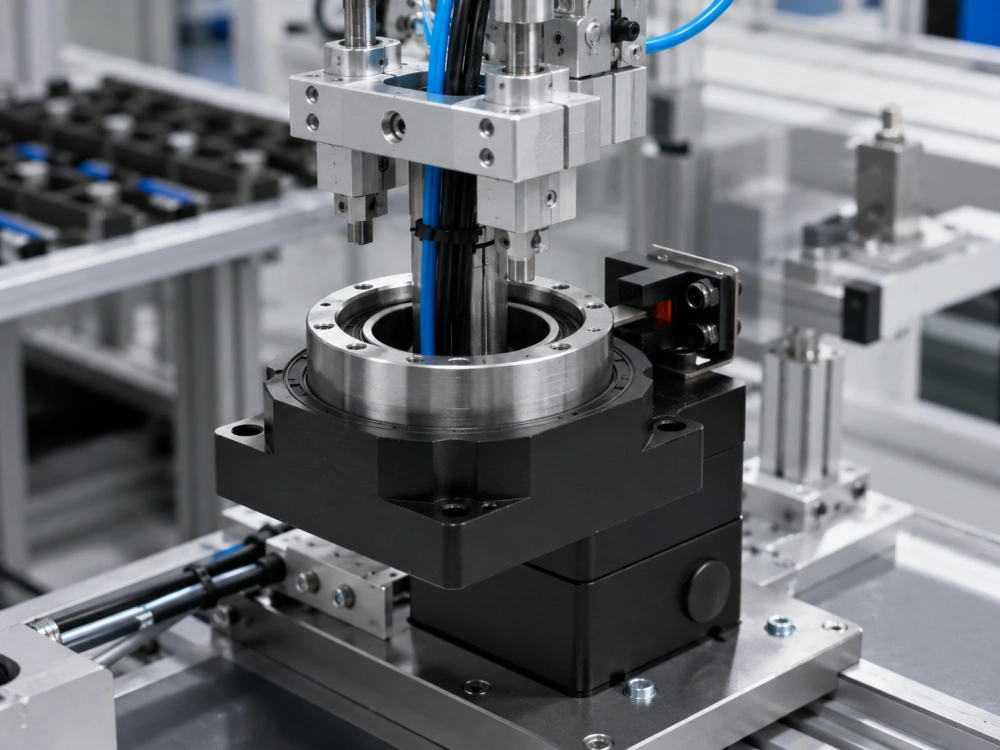
A hollow rotary table is a good choice when the application requires rotary positioning, fixture support, compact structure, and center cable routing.
It is especially suitable when:
- the machine needs a rotating fixture
- cables or tubes need to pass through the center
- positioning repeatability is important
- installation space is limited
- the load needs stable bearing support
- the machine uses servo-driven automation
- the equipment needs clean structure and easy maintenance
For many automation projects, a hollow rotary table is more practical than building a separate motor, gearbox, bearing, coupling, and fixture support system.
Work with a Manufacturer for Model Selection
Catalog data is useful, but rotary actuator selection often depends on real machine conditions. Two applications may use the same table size but need different torque, bearing support, motor interface, or accuracy grade.
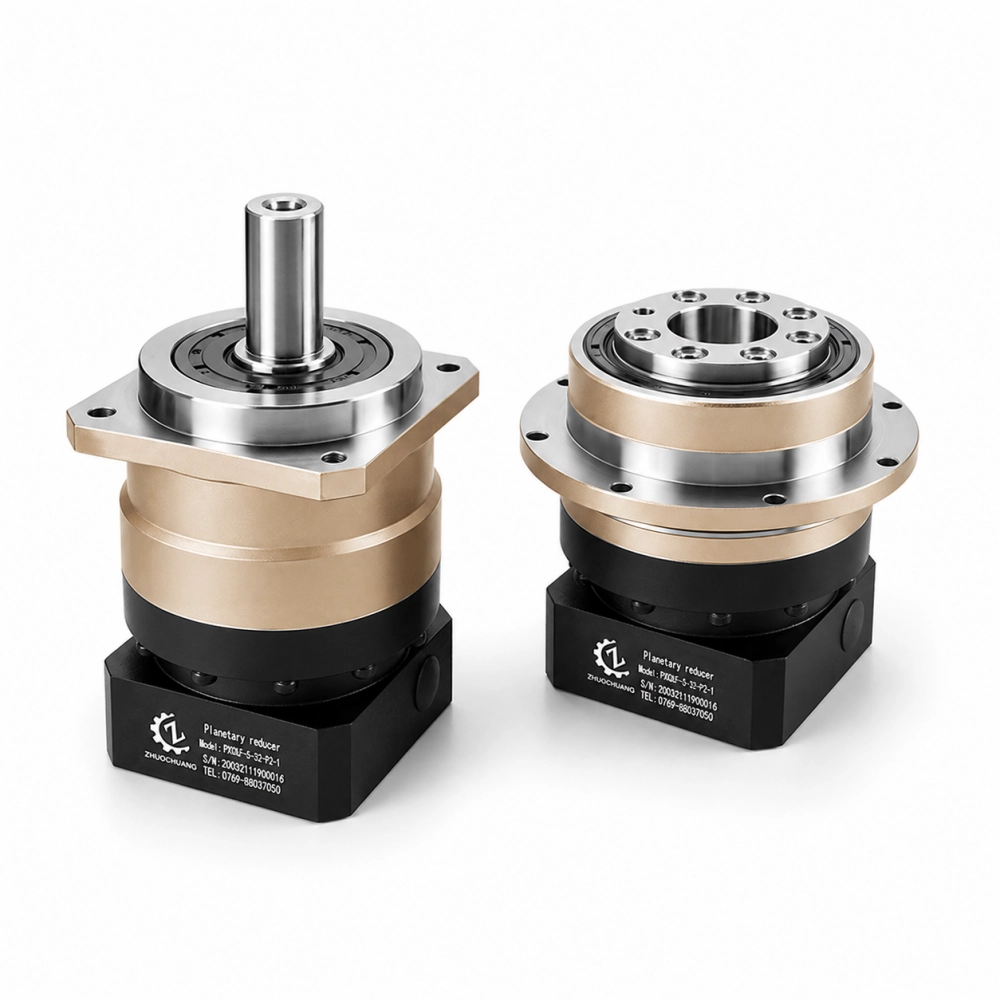
Dongguan Zhuochuang Precision Machinery Co., Ltd provides precision transmission products for automation equipment, robotics, CNC-related machinery, packaging systems, inspection machines, and industrial motion control applications. Our product range includes hollow rotary tables, hollow rotary platforms, planetary gearboxes, right-angle gearboxes, and servo gearbox solutions.
If you are selecting a rotary actuator for a new machine or replacement project, you can contact our technical team with your load, fixture size, required angle, cycle time, motor information, and installation drawing. These details help us recommend a more suitable rotary positioning solution.
Conclusion
A rotary actuator may look like a simple motion component, but its selection affects machine accuracy, stability, layout, and long-term reliability.
Pneumatic rotary actuators are suitable for simple limited-angle movement. Hydraulic actuators are useful for heavy-duty force applications. Electric and servo rotary actuators are better for programmable automation. Hollow rotary actuators and hollow rotary tables are especially useful when compact design, fixture support, and cable routing are important.
For machine builders, the best choice is not always the most expensive actuator or the highest catalog accuracy. The right choice is the actuator that matches the load, motion pattern, installation space, control method, and long-term production requirements.
FAQ
What is the difference between a rotary actuator and a rotary table?
A rotary actuator produces rotary motion. A rotary table is usually a table-style component that supports a workpiece or fixture while rotating. Some hollow rotary tables can also function as rotary actuators in automation equipment.
What is a hollow rotary actuator?
A hollow rotary actuator is a rotary motion unit with a center through-hole. The hollow bore allows cables, air tubes, vacuum lines, or fixture wiring to pass through the center of the rotating structure.
Is a servo rotary actuator better than a pneumatic rotary actuator?
It depends on the application. A pneumatic rotary actuator is suitable for simple fixed-angle motion. A servo rotary actuator is better when the machine needs programmable angles, controlled speed, repeatability, and flexible automation.
What should I check before choosing a rotary actuator?
You should check rotation angle, load, torque, moment load, repeatability, backlash, speed, duty cycle, installation space, control method, and whether a hollow bore is required.
When should I choose a hollow rotary table?
Choose a hollow rotary table when the machine needs rotary positioning, stable fixture support, compact layout, and cable or air tube routing through the center.