
Conveyor Gearbox Selection Guide: How to Choose the Right Drive
A conveyor gearbox reduces motor speed and delivers the output torque required to move a belt, chain, roller, or timing-belt conveyor. Selecting the correct gearbox requires more than matching a catalog model to motor power. Engineers must also consider output speed, acceleration torque, load inertia, duty cycle, start-stop frequency, radial load, mounting space, and environmental conditions.
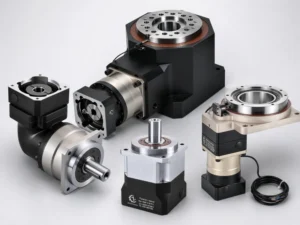
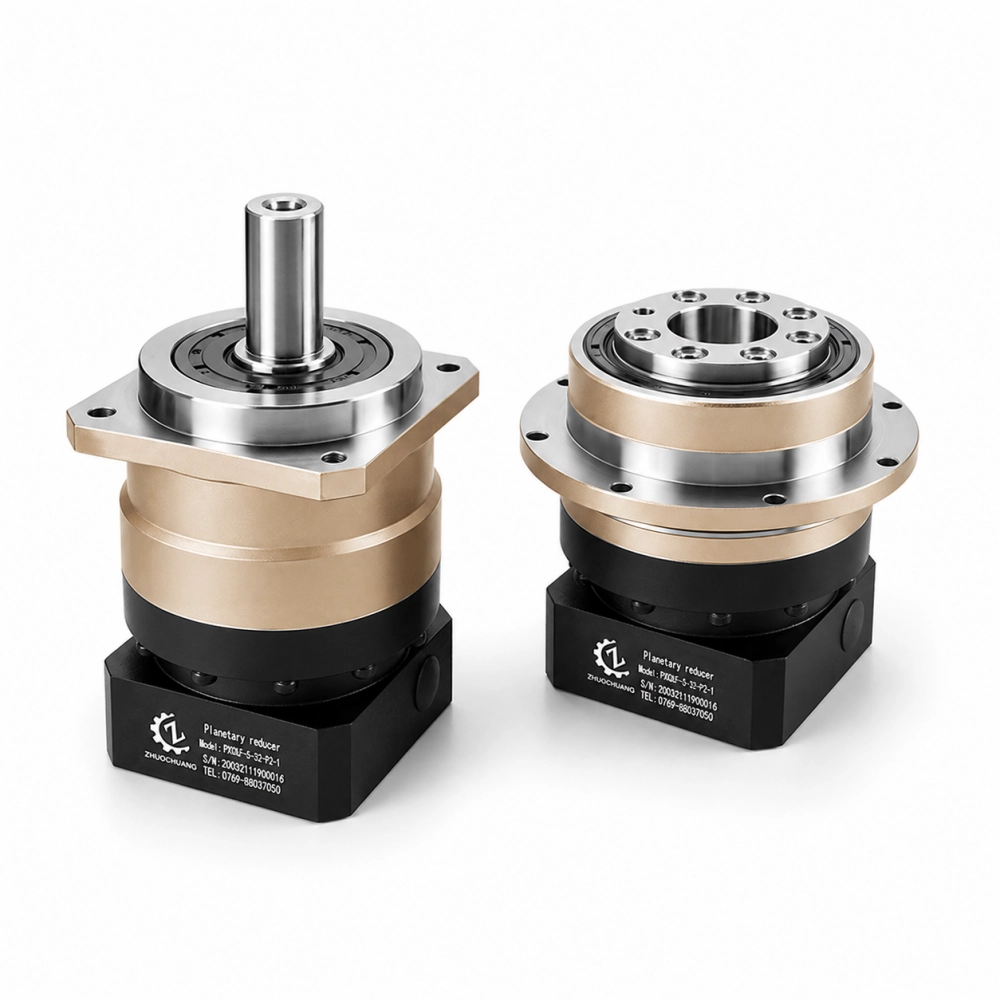
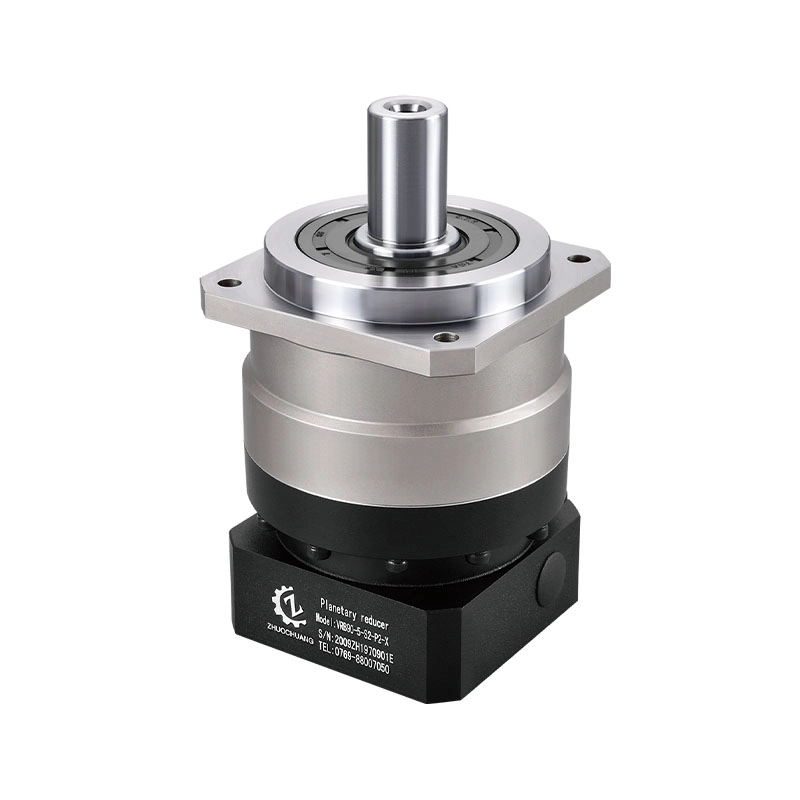
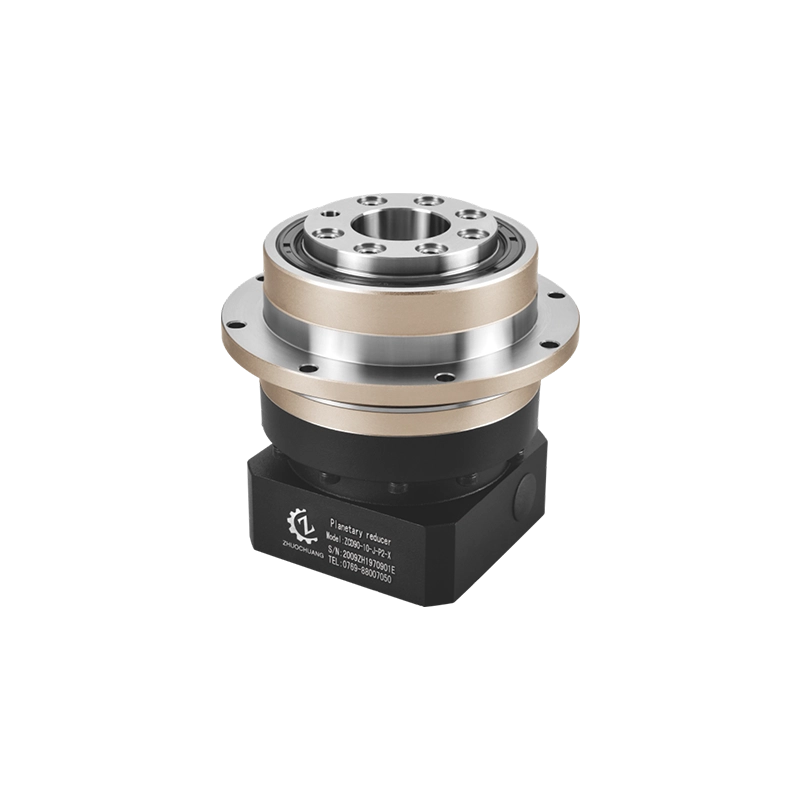
For compact automation equipment, packaging lines, assembly systems, and indexing conveyors, a precision planetary gearbox can provide high torque density, compact dimensions, high transmission efficiency, and stable servo positioning. However, planetary gearboxes are not the best choice for every conveyor. Long-distance bulk-material conveyors and large continuous-duty systems often use industrial helical, parallel-shaft, or bevel-helical reducers.
Quick Answer: Choose a conveyor gearbox according to required output torque, conveyor speed, reduction ratio, duty cycle, mounting layout, and operating environment. Precision planetary gearboxes are particularly suitable for servo-driven timing-belt conveyors, indexing conveyors, start-stop transfer systems, and space-limited automation equipment. Always verify the selected gearbox using the manufacturer’s rated torque, peak torque, speed, radial load, axial load, and service-factor data.
Why Conveyor Gearbox Selection Often Goes Wrong
Many conveyor drive problems begin when a gearbox is selected only from motor power or nominal running torque. A conveyor is a dynamic system. The gearbox may experience higher loads during acceleration, deceleration, material accumulation, emergency stops, reversing, and frequent indexing cycles.
An apparently adequate gearbox may therefore develop excessive temperature, bearing wear, unstable positioning, or shortened service life when actual operating conditions differ from the original selection assumptions.
Common selection mistakes include:
- Ignoring acceleration and emergency-stop torque
- Selecting a reduction ratio without checking the required belt speed
- Using rated torque without applying a suitable service margin
- Ignoring pulley or sprocket radial load on the output shaft
- Using maximum input speed as a continuous operating speed
- Failing to consider start-stop frequency and daily operating hours
- Using an incorrect motor adapter or mounting interface
- Assuming that one gearbox type is suitable for every conveyor
Which Gearbox Type Fits Your Conveyor?
The best gearbox depends on how the conveyor operates. The following comparison is a general starting point; final selection should always be confirmed using the actual gearbox manufacturer’s specifications.
| Conveyor Application | Common Gearbox Choice | Selection Reason |
|---|---|---|
| Servo-driven timing-belt conveyor | Precision planetary gearbox | Compact size, high torsional rigidity, efficient servo transmission, and controlled backlash |
| Indexing or start-stop conveyor | Planetary or cycloidal gearbox | Suitable for frequent positioning cycles when properly sized for acceleration and peak torque |
| Compact packaging conveyor | Planetary, inline helical, or worm gearbox | Selection depends on accuracy, efficiency, cost, ratio, and installation space |
| Space-limited automation conveyor | Inline or right-angle planetary gearbox | High torque density and flexible motor installation layout |
| Long continuous belt conveyor | Helical or parallel-shaft gearbox | Common solution for continuous material handling and direct drum-drive layouts |
| Inclined conveyor | Bevel-helical, worm, or brake-equipped gearbox | May require a holding brake or other protection against back-driving |
| Mining or bulk-material conveyor | Heavy-duty parallel-shaft or bevel-helical gearbox | Designed for large continuous loads, harsh environments, and high radial forces |
Where Planetary Gearboxes Fit Conveyor Systems
A planetary gearbox is most valuable when a conveyor requires compact servo transmission, frequent acceleration and deceleration, accurate indexing, or limited installation space.
Instead of relying on one gear pair, a planetary transmission distributes torque through multiple planet gears. This provides high torque density in a relatively compact coaxial structure.
Servo-Driven Indexing Conveyors
Indexing conveyors move a product to a defined position, stop for an assembly or inspection process, and then move to the next station. These applications need accurate response, stable output, and sufficient peak torque during acceleration.
Low backlash is particularly important when the conveyor must repeatedly align a fixture, tray, camera target, or assembly component. See our low-backlash planetary gearbox guide for more information.
Packaging and Labeling Equipment
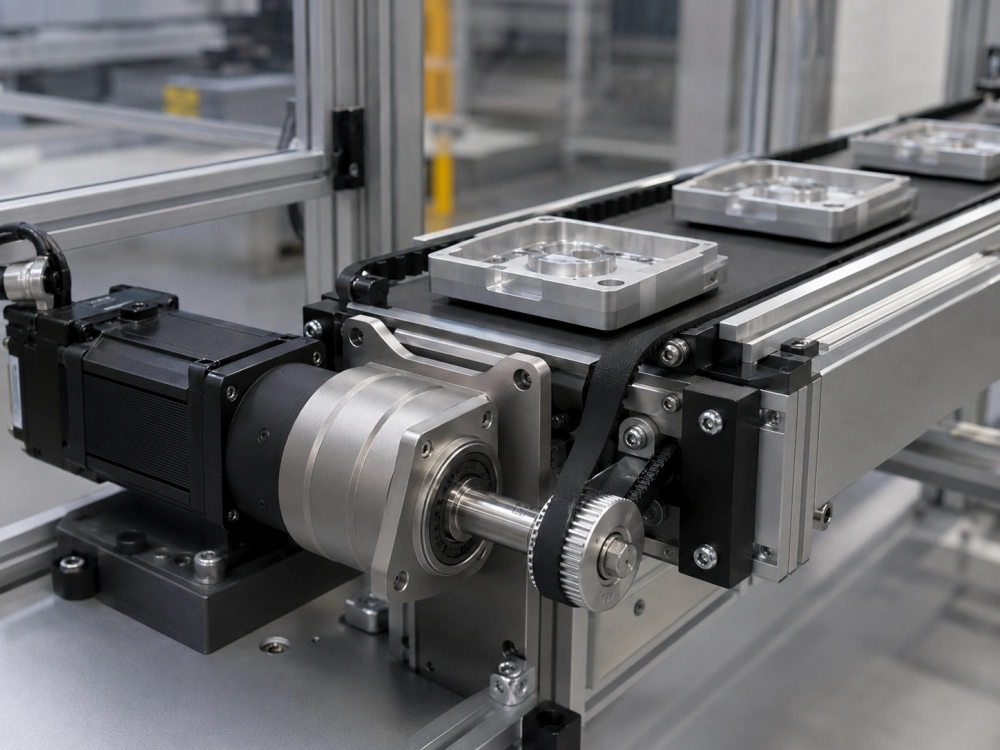
Packaging systems often use multiple synchronized conveyor axes for feeding, spacing, labeling, filling, sealing, and product transfer. A compact planetary gearbox can help match servo motor speed to the required conveyor speed while keeping the drive system small.
Assembly and Inspection Lines
Automated assembly lines may use short timing-belt conveyors to position workpieces below robots, cameras, dispensers, or press units. In these applications, positioning stability and acceleration performance may be more important than the continuous-duty capability required by large material-handling conveyors.
Compact Right-Angle Conveyor Drives
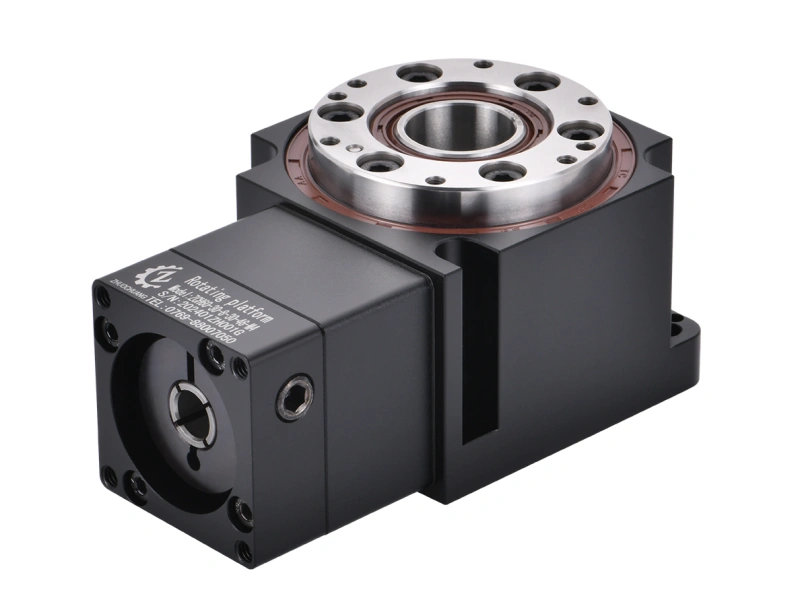
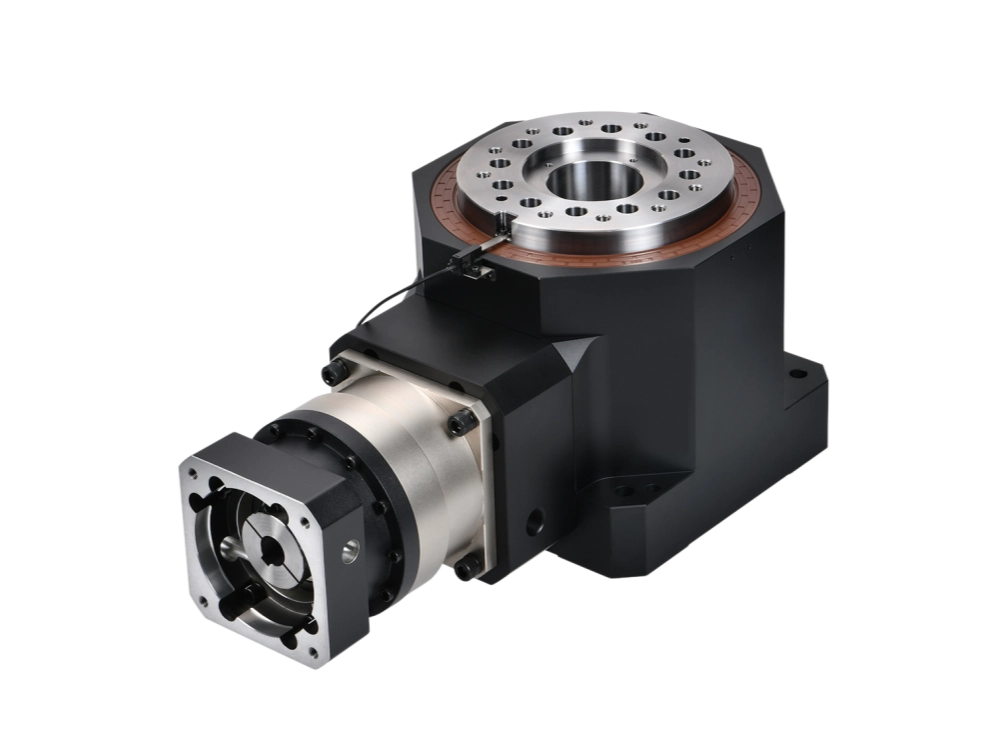
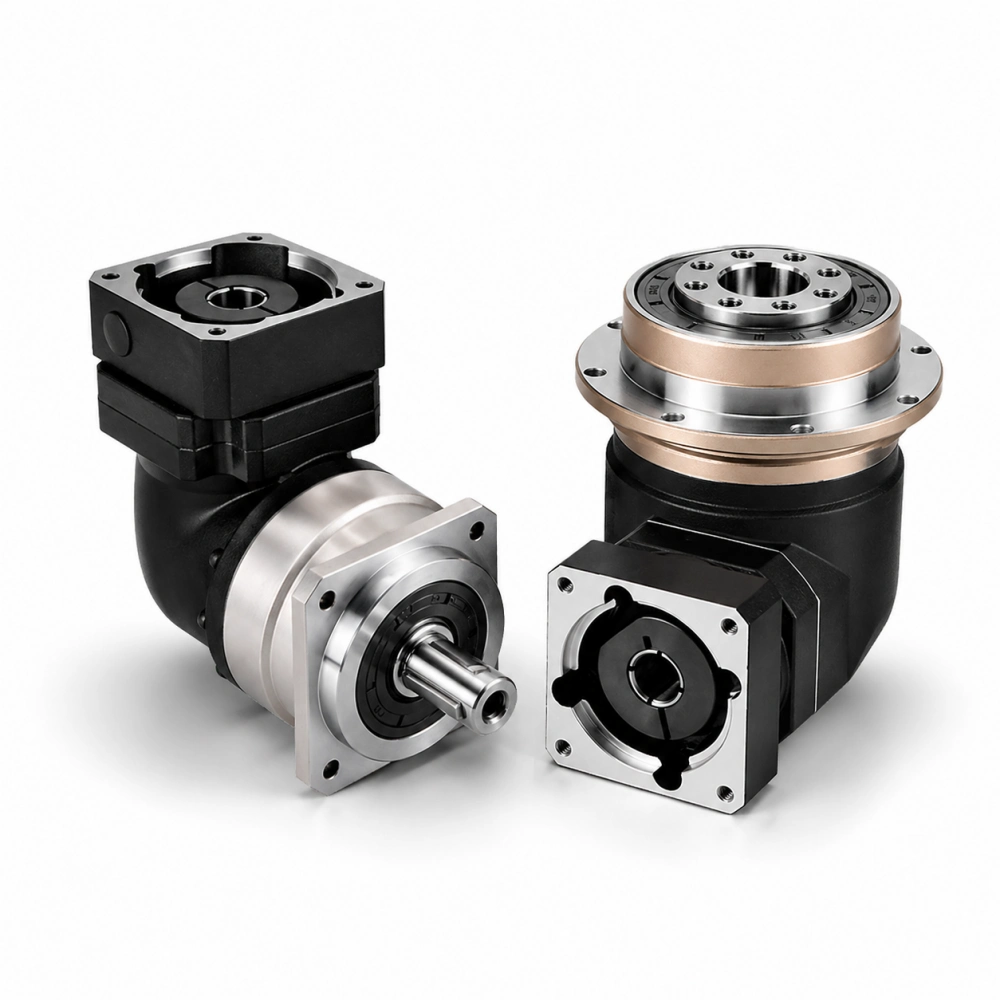
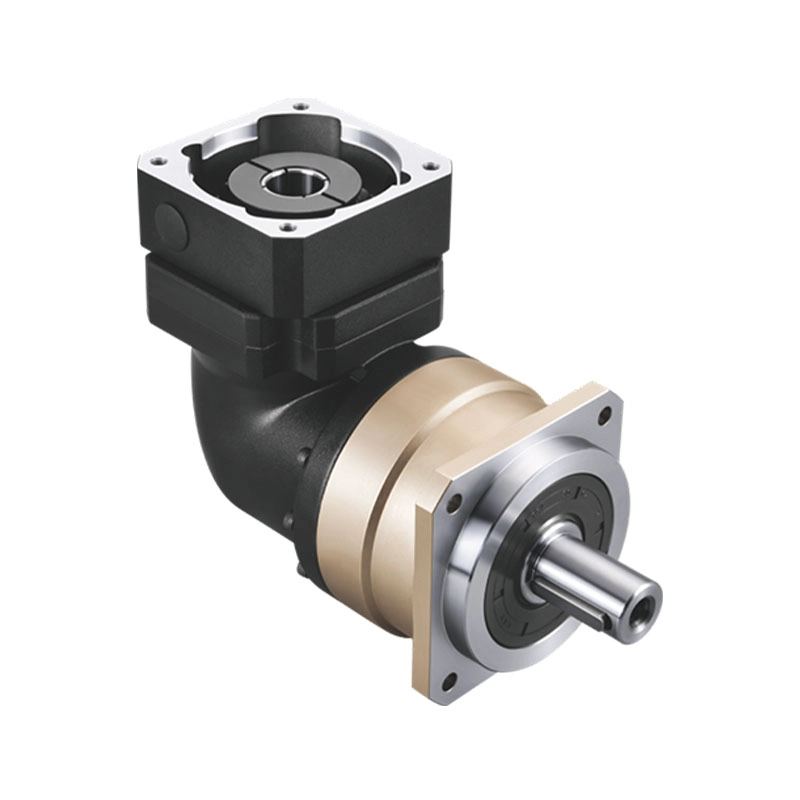
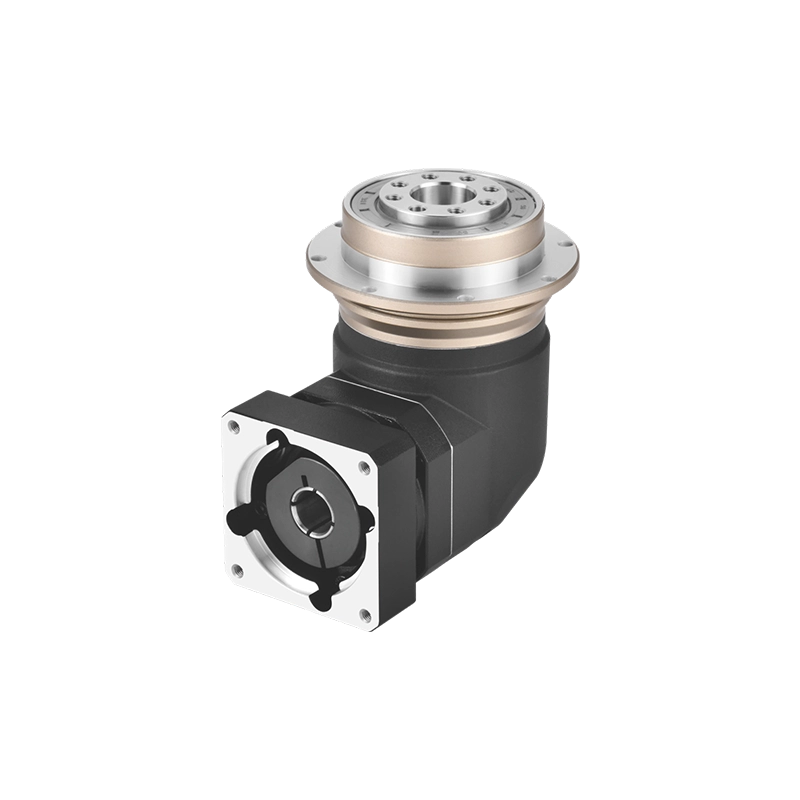
When the servo motor cannot extend in line with the conveyor, a ZCDR right-angle planetary gearbox can redirect the motor position by 90 degrees. This can reduce the required machine width and simplify integration into enclosed automation equipment.
Advantages of Planetary Gearboxes for Servo Conveyors
- Compact torque transmission: High torque capacity can be achieved in a relatively small frame.
- High efficiency: Published specifications for selected Zhuochuang models list efficiency of at least 97% for one-stage units and at least 94% for two-stage units.
- Controlled backlash: Suitable for servo positioning, indexing, and synchronized conveyor motion.
- High torsional rigidity: Helps reduce output deflection during acceleration, stopping, and load changes.
- Motor matching options: Input adapters can be configured according to servo motor shaft, pilot, flange, and mounting dimensions.
- Inline and right-angle layouts: Different configurations support coaxial and space-saving conveyor installations.
For a more detailed explanation of transmission losses, see our planetary gearbox efficiency guide.
How to Size a Conveyor Motor Gearbox
Conveyor gearbox sizing should start from the driven load rather than motor power alone. The following calculations provide a preliminary engineering framework.
1. Calculate Required Output Speed
For a belt conveyor, output speed can be estimated from belt speed and drive-pulley diameter:
nout = (v × 60) / (π × D)
Where:
- nout = pulley speed in RPM
- v = belt speed in meters per second
- D = drive-pulley diameter in meters
For example, a conveyor belt moving at 1.5 m/s with a 0.4 m drive pulley requires:
nout = (1.5 × 60) / (π × 0.4) ≈ 71.6 RPM
2. Calculate the Reduction Ratio
The preliminary gearbox ratio is:
i = nmotor / nout
A motor operating at 1,450 RPM and driving a pulley at 71.6 RPM requires a ratio of approximately 20:1.
For servo-driven conveyors, use the motor speed expected during the actual machine cycle rather than automatically using maximum motor speed. Our planetary gearbox ratio guide explains ratio selection in more detail.
3. Estimate Conveyor Driving Force
The required conveyor force may include:
- Frictional resistance
- Force required to move the conveyed product
- Incline or lifting force
- Acceleration force
- Belt, chain, bearing, and guide resistance
- Additional process forces at the conveyor station
A simplified relationship is:
Ftotal = Ffriction + Fincline + Facceleration + Fprocess
4. Calculate Required Drum Torque
After estimating the total conveyor force, calculate drive-pulley torque:
Tdrum = (Ftotal × D) / (2 × ηdrive)
Where:
- Tdrum = required pulley torque in N·m
- Ftotal = total conveyor resistance in N
- D = pulley diameter in meters
- ηdrive = estimated efficiency of the driven mechanism
The gearbox rated output torque must exceed the calculated continuous torque after applying an appropriate margin for duty cycle and operating conditions. Peak output torque must also be checked for acceleration, deceleration, emergency stops, and temporary material accumulation.
5. Cross-Check Torque from Motor Power
Torque can also be cross-checked from motor power and gearbox output speed:
Tout = (9550 × P × ηgearbox) / nout
Where P is motor input power in kW. This calculation estimates the torque available from the motor and gearbox; it does not replace a load-based conveyor calculation.
Checks Beyond Torque and Ratio
Duty Cycle and Start-Stop Frequency
A gearbox operating intermittently has more time to dissipate heat than one running continuously. Frequent indexing and reversing also increase the number of acceleration events. Provide starts per hour, operating hours per day, acceleration time, deceleration time, and dwell time when requesting a gearbox recommendation.
Service Factor
Service factor accounts for operating time, shock load, load variation, and application severity. The required value depends on the selected gearbox type and manufacturer’s rating method. Do not apply one fixed service-factor table to every planetary, worm, or helical gearbox.
Thermal Capacity
Continuous operation generates heat that must be dissipated through the gearbox housing and surrounding air. High ambient temperature, restricted airflow, installation orientation, input speed, and duty cycle can affect allowable continuous operation.
Verify thermal suitability using the selected manufacturer’s data rather than applying a universal percentage derating rule.
Radial and Axial Load
A pulley or sprocket mounted directly on the gearbox output shaft may create substantial radial load. The actual bearing load depends on belt tension, chain force, pulley diameter, load direction, and the distance between the load and gearbox bearing.
Compare the calculated radial and axial loads with the manufacturer’s allowable values at the actual output speed and mounting position. An external bearing support may be required when the pulley load exceeds the gearbox capacity.
Motor and Gearbox Interface
For a servo motor, confirm:
- Motor brand and complete model
- Motor shaft diameter and shaft length
- Motor pilot diameter
- Motor flange dimensions
- Mounting-hole pitch
- Mounting-screw size
- Rated and maximum motor speed
Illustrative Energy-Cost Comparison
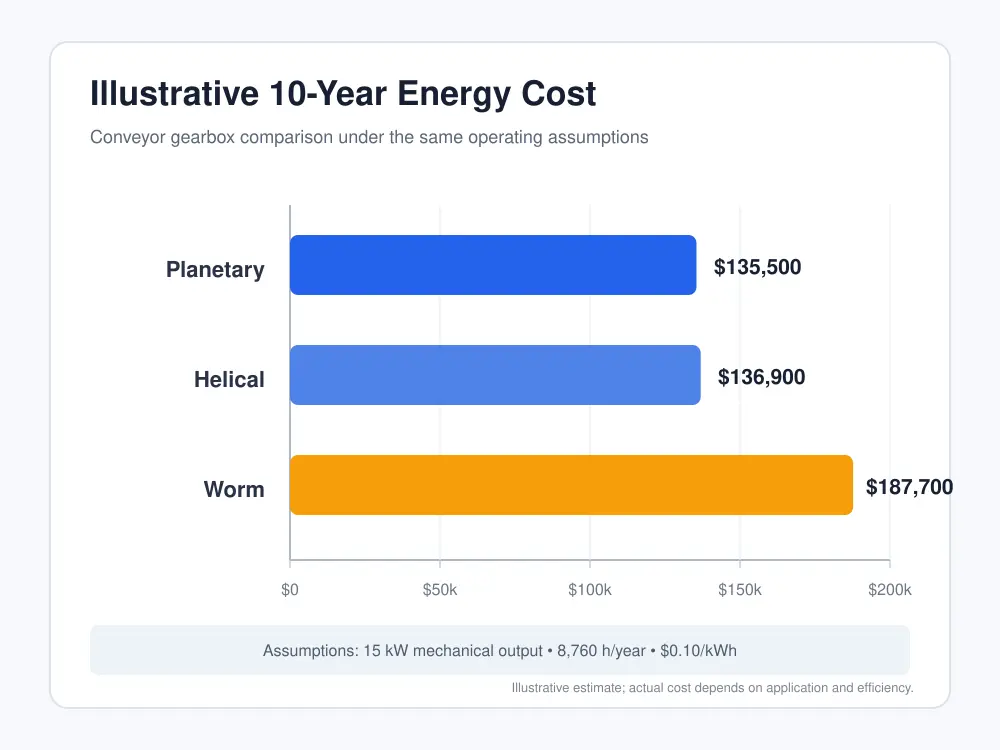
Gearbox efficiency can affect long-term electricity consumption, especially when a conveyor runs for many hours at a relatively stable load.
The following simplified example assumes:
- 15 kW constant mechanical output
- 8,760 operating hours per year
- Electricity price of $0.10/kWh
- Fixed efficiency throughout operation
- No variation in load, electricity price, maintenance, or downtime
| Gearbox Type | Assumed Efficiency | Estimated Annual Cost | Estimated 10-Year Cost |
|---|---|---|---|
| Planetary | 97% | Approximately $13,550 | Approximately $135,500 |
| Helical | 96% | Approximately $13,690 | Approximately $136,900 |
| Worm | 70% | Approximately $18,770 | Approximately $187,700 |
This is an illustrative comparison, not a guaranteed operating-cost result. Actual efficiency varies with ratio, gearbox size, speed, temperature, lubrication, and load. The correct gearbox should be chosen according to the complete mechanical and operating requirements—not efficiency alone.
Common Conveyor Gearbox Problems
Even a correctly selected conveyor gearbox can develop operating problems if it is overloaded, incorrectly aligned, exposed to excessive radial load, or installed in unsuitable environmental conditions. Common warning signs include abnormal temperature, unusual noise, vibration, lubricant leakage, increasing backlash, and unstable conveyor positioning.
These symptoms should not be ignored because a minor installation or lubrication problem can gradually lead to bearing damage, gear wear, seal failure, or unplanned conveyor downtime. For detailed causes, diagnostic steps, inspection points, and preventive measures, read our conveyor belt gearbox problems and maintenance guide.
- Overheating: May indicate overload, excessive speed, poor heat dissipation, incorrect gearbox sizing, or internal wear.
- Noise and vibration: Can result from misalignment, loose mounting, bearing damage, gear wear, or an unstable driven load.
- Lubricant leakage: May be caused by damaged seals, excessive internal temperature, incorrect installation, or pressure buildup.
- Premature bearing wear: Often relates to excessive pulley radial load, shaft misalignment, or unsuitable mounting conditions.
- Positioning error: In servo indexing conveyors, increasing backlash or coupling movement can reduce stopping accuracy and repeatability.
Maintenance requirements depend on the gearbox design. Sealed precision planetary gearboxes should not be opened or relubricated unless instructed by the manufacturer, while oil-lubricated industrial conveyor gearboxes must follow their specified oil inspection and replacement schedule.
Information to Send Your Gearbox Supplier
To receive an accurate conveyor gearbox recommendation, provide:
- Conveyor type: belt, timing belt, chain, roller, screw, or bucket
- Application: continuous conveying, indexing, positioning, or synchronized transfer
- Material or product being conveyed
- Total moving mass and maximum load
- Required belt or chain speed
- Drive-pulley or sprocket diameter
- Servo motor brand and complete model
- Motor power, rated speed, and maximum speed
- Required output speed and preferred ratio
- Acceleration and deceleration time
- Starts and stops per hour
- Daily operating hours and duty cycle
- Shock-load condition
- Mounting orientation
- Available installation space
- Ambient temperature, dust, moisture, or washdown conditions
- Radial and axial load on the output shaft
- Required backlash and positioning accuracy
With this information, the supplier can evaluate gearbox type, ratio, frame size, rated torque, peak torque, speed, output load, motor interface, and installation layout.
Frequently Asked Questions
What is the best gearbox for a conveyor system?
There is no single best gearbox for every conveyor. Precision planetary gearboxes are suitable for compact servo-driven, indexing, start-stop, and positioning conveyors. Long continuous belt conveyors often use helical or parallel-shaft gearboxes, while inclined conveyors may require a brake or other holding mechanism.
How do I select a gearbox for a conveyor?
Start with required conveyor speed, pulley diameter, total driving force, output torque, and reduction ratio. Then verify acceleration torque, duty cycle, input speed, radial load, axial load, mounting dimensions, environmental conditions, and the motor interface.
How do I calculate the conveyor gearbox ratio?
Divide the expected motor speed by the required gearbox output speed:
i = nmotor / nout
For example, a motor operating at 1,450 RPM and a required pulley speed of 71.6 RPM need a preliminary ratio of approximately 20:1.
When should I use a planetary gearbox on a conveyor?
Use a planetary gearbox when the conveyor is servo-driven and requires compact dimensions, frequent acceleration, precise indexing, synchronized motion, or limited backlash. It may not be the most economical option for a large continuous bulk-material conveyor.
Can a planetary gearbox replace a worm gearbox?
Replacement is possible only after confirming ratio, torque, speed, motor interface, output shaft, mounting dimensions, radial load, installation space, and holding requirements. A planetary gearbox is normally back-drivable, so a brake or other holding device may be required if the original conveyor relied on worm-gear self-locking.
How often should a conveyor gearbox be inspected?
Inspection frequency depends on the gearbox type, conveyor duty, and environment. For sealed precision planetary gearboxes, regularly check temperature, noise, vibration, mounting screws, shaft alignment, and lubricant leakage. Do not open or add lubricant unless instructed by the manufacturer. Oil-lubricated industrial gearboxes should follow their own manufacturer-specified oil inspection and replacement schedule.
Conveyor Planetary Gearbox Support from Zhuochuang
Dongguan Zhuochuang Precision Machinery Co., Ltd. supplies precision planetary gearboxes for servo-driven automation, packaging machinery, robotics, assembly equipment, and compact conveyor systems.
Our inline planetary gearboxes support compact coaxial conveyor layouts, while right-angle planetary gearboxes are suitable for installations where the motor must be positioned at 90 degrees to the driven axis.
Contact our engineering team with your conveyor type, motor model, load, speed, pulley diameter, duty cycle, and installation space. We can help compare the required ratio, torque, frame size, output load, and motor interface for your application.